
Serving Chicago • Cook County • Lake County • DuPage County

How to Win a Property Tax Appeal and Cut Your Annual Tax Expenses

Property tax appeal guide for challenging overvalued property assessments and lowering annual tax expenses

Property tax appeal is something many property owners only think about when the tax bill suddenly feels too high. You open that notice, look at the number, and immediately feel it does not match what your property is actually worth.

That moment is usually where a property tax appeal service starts.

It is the process of telling the tax office, “I think my property has been valued too high, and here is why.”

And when done correctly, it can lead to real property tax reduction every single year.

Why does This Even Happen?

Let’s be honest. Tax assessments are not perfect.

They are based on estimates, old data, and general market assumptions. That means mistakes happen more often than people think.

Sometimes your property is:

  • valued like it was newly built when it is not
  • compared with better locations
  • measured incorrectly
  • or assigned wrong usage type

And that is exactly where a property tax appeal becomes important.

How Tax Value is Actually Decided

Most people never see the behind-the-scenes process.

The system usually looks at:

  • Recent sales nearby
  • Estimated construction costs
  • Land value in your area
  • Property size and condition
  • Rental or income potential

But here is the problem. These numbers are not always updated in real time.

So when market conditions change, your tax bill does not always change correctly.

That gap is where a property tax appeal works in your favor.

Market Value vs What They Think your Property is Worth

Think of it like this.

Market value is what someone is actually willing to pay today.

Assessed value is what the system believes your property is worth based on formulas.

Those two are not always equal.

When they are far apart, your taxes go up unfairly, and that is when a property tax appeal makes sense.

Property tax appeal process showing assessment review, market analysis, evidence gathering, filing, and tax reduction

The Appraisal Home Value Process in Real Life

When an assessor looks at your property, they are not always visiting it in detail.

They often rely on:

  • Records
  • Satellite data
  • Older inspections
  • Standard pricing models

This is called the property appraisal process, and it is where errors usually start.

A small mistake here can increase your yearly taxes for years.

Why a Market Value Appraisal Changes Everything

A market value appraisal for house is basically a second opinion.

A professional comes in and says, “This is what the property is actually worth in today’s market.”

It includes:

  • Real sale comparisons
  • Location changes
  • Condition of the building
  • Current demand

This becomes one of the strongest tools in a property tax appeal because it replaces assumptions with real numbers.

Commercial Property Owners Feel this More

If you own commercial space, you already know this is more complicated.

Because now the valuation is not just land and building. It also includes:

  • Rental income
  • Vacancy rates
  • Business demand
  • Future development potential

That is why commercial property tax appeals often require more documentation and deeper financial analysis.

A small mistake in income assumptions can significantly increase property tax liabilities.

Why your Tax Bill Affects your Real Money

Higher taxes do not just look bad on paper.

They directly affect:

  • Rental profit
  • Resale value
  • Investment returns

So a property tax appeal is not just paperwork. It is a financial correction.

Even a small reduction can save a large amount over time.

What Actually Helps You Win

Let’s keep it simple.

A strong case usually includes:

  • updated appraisal reports
  • proof of market value differences
  • correct property records
  • comparable sales in your area

These documents are what turn a weak claim into a successful property tax appeal.

Construction Cost Mistakes People Ignore

One hidden factor is construction costs.

Tax systems sometimes assume rebuilding your property would cost more than it actually would today. When this number is wrong, your valuation becomes inflated. Fixing this detail alone can support a stronger property tax appeal.

Simple Way to Understand the Appeal Process

Here is how it usually flows:

  • You receive your tax notice
  • You compare it with real market value
  • You gather supporting documents
  • You file a challenge
  • You wait for review or hearing

This is the basic property assessment appeal journey.

Where most people go wrong

Most rejections happen not because the case is weak, but because:

  • evidence is incomplete
  • deadlines are missed
  • comparisons are not relevant
  • reports are unclear

A properly prepared property tax appeal avoids these mistakes.

Why consulting help matters

Many people handle it alone and get stuck.

But property tax consulting helps because experts:

  • know how assessors think
  • understand valuation rules
  • prepare stronger documentation
  • improve chances of approval

It saves time and often increases results in a property tax appeal.

Conclusion:

At the end of the day, the goal is simple. You are not trying to avoid taxes. You are trying to make sure your property is taxed fairly based on real market value. That is what a property tax appeal is really about.

Frequently Asked Questions

Why should I file a property tax appeal?

Because your property may be overvalued compared to real market conditions.

How do I know if my taxes are too high?

If your assessed value is much higher than recent sales in your area, it may be overvalued.

Do I need an appraiser home value?

Not always, but a market value appraisal makes your case much stronger.

Can commercial properties reduce taxes more easily?

Yes, because valuation errors are more common in commercial assessments.

How long does the process take?

It depends on your region, but usually a few weeks to a few months.

Can commercial property owners benefit more than homeowners?

In many cases yes, because commercial valuations include income, rent assumptions, and market projections. it  can correct these complex calculations and reduce liabilities.

What documents should I prepare before filing?

You should gather appraisal reports, recent comparable sales, property records, and any correction evidence. These strengthen your property tax appeal significantly.

What is the difference between assessment and appraisal?

Assessment is done by the tax office using formulas, while appraisal is an independent estimate of real market value. A property tax appeal often relies on appraisal to challenge assessment.

Can construction cost errors affect my taxes?

Yes, if outdated or incorrect construction cost data is used, it can inflate your valuation. Fixing this is often part of a property tax appeal strategy.

Do I get a refund if my appeal is approved?

In many cases, yes. If your taxes were overpaid due to incorrect valuation, a successful property tax appeal may result in refunds or credits.


Why Commercial Real Estate Appraisal Matters Before Buying or Selling Property

Commercial real estate appraisal before buying or selling property

Commercial real estate appraisal is basically that moment where everything becomes clear in real estate. Before any big decision is made, before money changes hands, before a property gets listed or bought, this is the step that quietly decides what the property is actually worth in the real world.

Not what someone hopes it is worth. Not what an owner feels it should be. But what the market is ready to pay for right now.

That is what commercial real estate appraisers do. It pulls everything back to reality.

And in commercial property, that reality matters a lot more because the numbers are bigger, the risks are higher, and the mistakes are far more expensive.

What is Really Happening in Commercial Real Estate Appraisal

When people hear commercial real estate appraisal, it can sound technical, but in simple terms it is just a structured way of answering one question:

“What is this commercial property truly worth today?”

Commercial appraisal looks at income, location, condition, demand, and market trends. It studies how much money the property can generate and how strong the demand is in that area.

So instead of guessing, everything is broken down into real signals from the market.

For example, a shop in a busy commercial street will not be valued the same as a warehouse in a low-demand area. Even if both are the same size, the value changes because the earning potential is different.

That is the heart of commercial real estate appraisal.

Why this Step Matters so Much Before Any Deal

In real estate, most problems start when pricing is wrong.

Commercial appraisal prevents that.

Before selling or buying, this process gives a clear direction so no one is operating in confusion. Sellers avoid pricing too high and sitting on the market for months. Buyers avoid paying more than what the property can actually deliver in returns.

Even in situations like selling my house or selling home assets that include commercial units, this becomes even more important because one wrong number can affect the entire financial outcome.

And when someone is thinking about selling my home, especially if part of it has commercial use or rental space, knowing the true value becomes the difference between a smart deal and a stressful one.

Commercial real estate appraisal keeps everything balanced.

How is the Valuation Actually Understood?

It follows a clear flow that almost feels like building a full story of the property.

It usually starts with inspection. The building is checked properly, inside and out. Then comes the market study, where similar properties are compared. After that, income is analyzed, especially if rent is involved.

Then comes cost thinking, like how much it would take to rebuild the property today. Finally, all of this is combined into one final value.

So instead of one opinion, there are multiple layers of reality coming together.

That is why real estate appraisal is trusted by banks, investors, and serious buyers.

What Actually Affects Property Value in The Real World

There are always a few things that can push value up or pull it down. And in commercial real estate appraisal, these are always checked carefully.

  • Location and how active the area is
  • Type of tenants and rental consistency
  • Condition of the building and maintenance level
  • Market demand in that region
  • Future development plans nearby

Each of these things quietly changes how buyers think and how investors calculate returns.

For example, a clean building in a growing commercial zone can gain value even if it is not fully rented yet. On the other hand, an older building in a slow market may lose value even if it is fully occupied.

That is how sensitive real estate appraisal really is.

Why skipping valuation causes problems

A lot of people skip proper valuation and go straight into pricing. That usually leads to issues.

Sometimes a property stays listed for too long because the price is too high. Other times, it sells quickly but the owner realizes later that it was undervalued.

Both situations come from missing proper commercial real estate appraisal. Accurate valuation is also important when property owners need a Tax Appeal Appraisal to challenge an assessment that may not reflect current market value.

Common mistakes include:

  • Setting price based on emotion instead of data
  • Ignoring repair or upgrade costs
  • Assuming rent will always stay the same
  • Using outdated comparisons from the market
  • Not consulting a professional real estate appraiser

These mistakes look small at first but create big financial gaps later.

Commercial real estate appraisal process and property valuation

The Role of Professionals in the Process

Commercial appraisal becomes far more accurate when handled by trained experts.

A real estate appraiser is not just looking at the building. They are reading the market, studying trends, comparing similar properties, and calculating risk.

Professional real estate appraisers follow structured methods so the valuation can stand in front of banks, investors, and legal processes without issues. The same valuation expertise is also used in specialized situations such as a Date of Death Appraisal, where an accurate historical property value is required for legal or estate purposes.

There are also real estate appraiser requirements they must meet, which include training, licensing, and understanding local market laws.

This is why their reports carry weight in financial decisions.

How this Helps Both Buyers and Sellers

Commercial real estate appraisal is not just useful for one side. It helps both.

For sellers, it sets a realistic price so the property attracts serious buyers instead of sitting idle. For buyers, it gives confidence that the property is not overpriced.

It also helps investors decide whether the property is worth holding long-term or should be sold.

In simple terms, it answers questions like:

  • Is this a fair deal
  • Is the income strong enough
  • Is the price justified
  • What is the future potential

That is why appraisal in real estate is seen as a decision-making tool, not just a report.

Comparing properties to understand value better

One of the most practical parts of commercial appraisal is comparison.

Properties are studied side by side to understand what the market is doing.

Property TypeIncome StrengthMarket ConditionValue Trend
Office SpaceStrongStableSteady rise
Retail UnitMediumActiveModerate
WarehouseHighGrowingStrong rise

This kind of comparison makes pricing easier to understand and more transparent.

Commercial property valuation follows the same idea, especially when investors are looking at multiple options before making a decision.

Why Timing Changes Everything

One thing that is often ignored is timing.

Commercial real estate appraisal is not fixed forever. Markets change. Interest rates shift. Demand rises or falls.

A property valued today might not hold the same number six months later.

That is why investors and serious buyers always look for updated valuation before making decisions.

Even small market changes can affect real estate appraisal results.

Emotional Thinking vs Real Market Thinking

Real estate often becomes emotional. Owners attach memories, effort, and expectations to a property.

But the market does not work on emotion.

Commercial real estate appraisal removes that emotional layer and focuses only on facts. Income, demand, condition, and future growth decide the value.

That is what keeps pricing fair across the industry.

Without this step, decisions become personal instead of financial.

Long-Term Thinking and Investment Growth

It is not only about buying and selling. It is also about long-term planning.

Investors use it to understand which properties are growing in value and which are slowing down.

It helps in deciding:

  • When to sell
  • When to renovate
  • When to hold
  • When to reinvest

This is where real wealth planning starts in real estate.

Simple Truth Behind Valuation

At the end of the day, real estate appraisal is about clarity.

It answers the question every buyer and seller actually cares about: what is this property really worth in today’s market.

Not last year. Not in the future. Right now.

That clarity is what makes deals smoother, faster, and safer.

Conclusion:

It is the foundation of smart property decisions and helps sellers avoid underpricing. It helps buyers avoid overpaying and helps investors stay confident in their choices.

Without it, the market becomes guesswork. With it, decisions become structured and clear.

That is why commercial real estate appraisal stays at the center of every serious commercial property transaction.

Frequently Asked Questions

What does commercial real estate appraisal?

It tells the real market value of a commercial property based on income, condition, demand, and location instead of assumptions or emotional pricing.

Why do buyers rely on commercial appraisal before purchasing?

Because it helps confirm if the asking price is fair and whether the property can actually generate enough return in the current market conditions.

Who usually performs real estate appraisal?

A trained and certified real estate appraiser who studies market data, inspects the property, and compares similar buildings to determine fair value.

Can real estate appraisal change over time?

Yes, it can change based on market trends, interest rates, local development, and demand shifts in the surrounding area.

Why is location so important in commercial real estate appraisal?

Because location directly affects customer traffic, rental income potential, and long-term demand, which all influence property value.

Is real estate appraisal needed for loans?

Yes, banks require it to make sure the property value supports the loan amount and reduces financial risk for lending institutions.

How does rental income affect property value?

Higher and stable rental income usually increases property value because it shows strong earning potential for investors.

What happens if appraisal value is lower than expected?

The seller may need to adjust price, improve the property, or renegotiate, while buyers may use it to secure better terms.

How often should a property be appraised?

It is usually done every few years or whenever major financial decisions, refinancing, or market changes occur.

What is the biggest benefit of commercial real estate appraisal?

The biggest benefit is clarity, it removes guesswork and helps every decision be based on real market data instead of assumptions.

The Hidden Value Most Couples Miss in Divorce Settlement Appraisals

Divorce settlement appraisal showing a property valuation report, house model, and legal documents for fair settlement

Divorce settlement appraisals often get treated like just another legal step in the background of a separation. Something to “tick off” and move on. But in reality, this is where most of the financial fairness is either protected or completely lost.

Because once emotions enter the picture, numbers start getting distorted. And when numbers are off, the settlement quietly becomes uneven without anyone noticing right away.

That is why divorce settlement appraisals end up carrying more weight than most people expect. They decide who gets what, who buys out whom, and what the real financial outcome actually looks like.

Why Divorce Settlement Appraisals Quietly Decide the Outcome

At the core, divorce settlement appraisals are not about paperwork. They are about grounding everything in real market value instead of personal perception.

What usually happens is simple:

  • One side believes the home is worth more
  • The other side disagrees
  • Online estimates create more confusion
  • Negotiations get stuck

And suddenly, a single divorce property appraisal becomes the biggest conflict point.

A proper valuation cuts through all that noise and brings one shared number both sides can work with.

The Part Most People Don’t See: Hidden Value Shifts

One of the biggest blind spots in appraisals is how many small details quietly change the final value.

Not obvious things. Subtle things.

Like:

  • A kitchen upgrade done years ago but never documented properly
  • A neighborhood that has recently increased in demand
  • Small structural improvements that actually add long-term value
  • Repair issues that reduce value but are ignored in discussions
  • Rental potential that one side completely overlooks

These things don’t feel big individually, but together they can shift the valuation significantly.

And that’s where most disagreements start.

When Emotions Start Controlling the Numbers

Homes are not just assets. They carry memories, routines, and emotional attachment. That is exactly why divorce settlement appraisals become sensitive.

Because emotion changes perception.

One side may feel:

  • The home is “worth more than market value”
  • The property should not be sold at current prices
  • The investment of time and money should be fully recognized

But the market does not adjust for emotion.

It only responds to demand, condition, and real comparable sales.

That gap between feeling and fact is where conflict usually lives.

Why valuation ethics matter more than people realize

Valuation ethics are what keep the entire process stable.

Without them, appraisal becomes opinion. And opinion cannot be used in legal or financial decisions.

Strong valuation ethics mean:

  • No favoring either party
  • No emotional influence
  • No pressure-based adjustments
  • Full transparency in how numbers are calculated

In divorce settlement appraisals, this neutrality is what makes the final value defensible and usable in real settlement discussions.

Divorce settlement appraisal with property valuation documents, calculator, house model, and settlement analysis

Replacement cost appraisal: the part most people ignore

A replacement cost appraisal is often not talked about enough in divorce situations, but it adds an important layer of understanding.

Instead of asking “what is it worth today,” it asks:

“How much would it cost to rebuild this property from zero?”

That shift in thinking reveals:

  • Whether the property is underinsured or overinsured
  • How much structural value exists beyond land price
  • Whether market price reflects real rebuilding cost

It doesn’t always decide the settlement, but it gives a deeper perspective that helps avoid undervaluation.

The Role of a Real Estate Appraiser for Divorce Cases

A real estate appraiser for divorce is not just a property evaluator. They act more like a neutral translator between two conflicting viewpoints, which is why a professional Divorce Appraisal can provide an objective foundation for settlement discussions.

Their job usually includes:

  • Inspecting the property in detail
  • Studying recent comparable sales
  • Adjusting value based on condition and location
  • Removing emotional bias from the calculation
  • Delivering a report that can stand in legal discussions

In most cases, they become the reason negotiations actually move forward instead of staying stuck.

How home appraisal for divorce shapes settlement decisions

Home appraisal for divorce is often the turning point in the entire process.

Because once the value is clear, decisions become much more structured:

  • Whether one party buys the other out
  • Whether the property should be sold
  • How equity will be divided
  • What refinancing looks like

Before the appraisal, everything is assumption. After it, everything becomes negotiation based on facts.

The Simple Breakdown of Divorce Settlement Appraisals

Here’s how divorce settlement appraisals usually unfold in real situations:

Property Inspection Stage

  • Physical walk-through of the home
  • Checking condition, upgrades, and damages
  • Recording all visible factors affecting value

Market Comparison Stage

  • Studying similar properties sold nearby
  • Matching size, location, and condition
  • Adjusting for current market demand

Final Valuation Stage

  • One clear market value is calculated
  • Supporting evidence is attached
  • A structured report is prepared for legal use

It sounds technical, but in practice, it’s about creating clarity where there is disagreement.

Emotional pricing vs professional valuation

SituationEmotional ThinkingProfessional Appraisal
Value perceptionBased on memory and attachmentBased on market data
Decision makingConflicted and biasedStructured and neutral
OutcomeOften disputedLegally usable
StabilityLowHigh

This is exactly why divorce appraisals are never left to guesswork in serious cases.

Mistakes that quietly damage settlement outcomes

A lot of problems come from avoidable choices:

  • Relying on online estimates instead of real inspection
  • Ignoring repairs or condition changes
  • Choosing someone without proper certification
  • Delaying the appraisal until late in negotiations
  • Letting emotions influence property value discussions

Each mistake adds friction and slows down closure.

Timing changes everything in valuation

Markets move constantly. A property value is never fixed for long. A valuation done at the wrong time can lead to an outdated settlement number. Similar timing considerations can also matter when a property is being evaluated for a Tax Appeal Appraisal, where current and well-supported valuation evidence can be important.

In divorce settlement appraisals, timing affects:

  • Buyer demand in the area
  • Interest rates and lending conditions
  • Local development and infrastructure changes
  • Seasonal buying patterns

A valuation done at the wrong time can lead to an outdated settlement number.

Why courts rely heavily on appraisal reports

In legal situations, divorce settlement appraisals often become one of the strongest pieces of evidence.

Because they provide:

  • Neutral third-party valuation
  • Structured reasoning behind numbers
  • Market-backed justification
  • Reduced room for dispute

When both parties cannot agree, courts trust documented valuation over personal opinion.

Simple Ways to Avoid Settlement Delays

  • Get appraisal done early, not at the end
  • Use certified professionals only
  • Keep financial expectations realistic
  • Review multiple comparable sales together
  • Stay transparent throughout the process

These steps reduce conflict and make the process smoother for both sides.

Frequently Asked Questions

Why are divorce settlement appraisals so important in separation cases?

Because they create a neutral and factual property value that both parties can rely on, removing emotional disagreement and making settlement discussions more balanced and structured.

How does a home appraisal for divorce affect who keeps the property?

The home appraisal for divorce sets the fair market value, which is used to calculate buyout amounts and decide whether one party can realistically retain ownership.

What role does valuation ethics play in divorce cases?

valuation ethics ensure the appraiser stays completely neutral, avoids bias, and provides an honest valuation that can be trusted in legal and financial decisions.

Why is replacement cost appraisal sometimes considered?

Because it shows the cost of rebuilding the property, helping understand real structural value beyond just market pricing, especially for insurance and asset clarity.

Can divorce appraisals be challenged in court?

Yes, but only if there are clear issues in methodology or bias. Otherwise, professionally conducted appraisals are usually accepted as strong evidence.

What happens when both parties disagree on valuation?

A second appraisal may be requested, or courts may average values or appoint an independent expert to finalize divorce settlement appraisals.

Is a real estate appraiser for divorce necessary in every case?

Not always legally required, but highly recommended because it reduces disputes and ensures a fair, structured valuation process.

How does home appraisal in divorce influence selling decisions?

Home appraisal in divorce helps determine whether selling is financially beneficial or if a buyout is more practical based on equity value.

Why do professional appraisals differ from online estimates?

Because online tools don’t inspect property condition, legal context, or local market adjustments, while professional divorce settlement appraisals include all of these factors.

What is the biggest mistake people make during appraisal?

Letting emotion influence expectations instead of trusting market-based valuation, which leads to conflict and delays in final settlement.

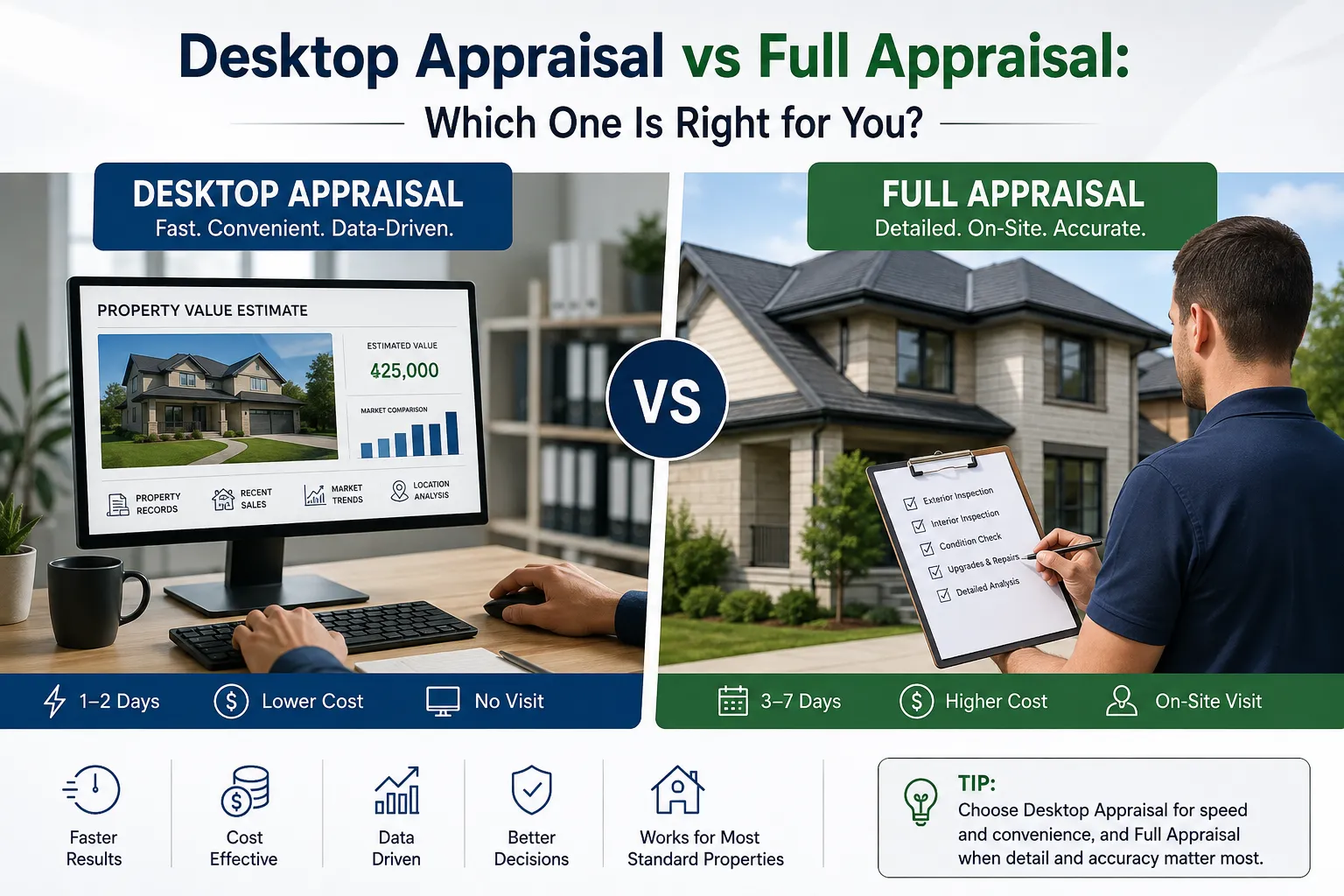
Desktop Appraisal vs Full Appraisal: Which One Is Right for You?

Desktop appraisal vs full appraisal showing property valuation differences

Desktop appraisal is basically the quick way of knowing what a property is worth without anyone going out to physically check it. No site visit, no walking around the house, no inspection in person. Everything is done from a desk appraisal using records, online data, maps, and recent property sales.

That is why desktop appraisal is getting so common now. It’s fast, it’s simple, and it helps banks and lenders make decisions without waiting days for a full inspection.

Desktop home appraisal is just a quick value estimate based on data that already exists.

What is a Desktop Appraisal?

A desktop appraisal is a property valuation done without visiting the property at all. Everything is handled through a computer using available information.

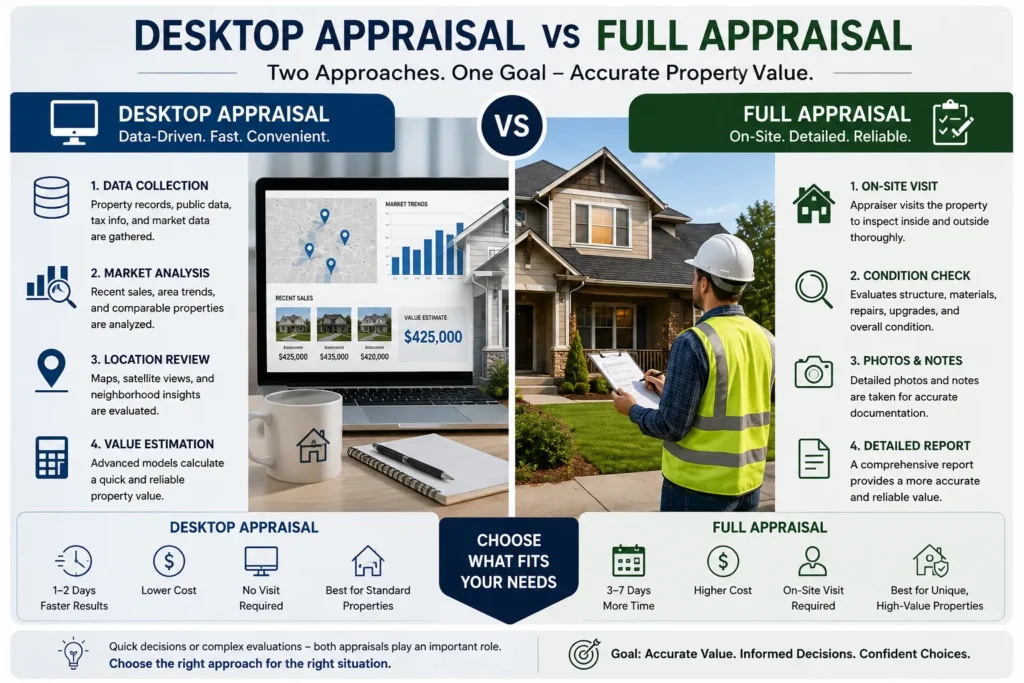
How it actually works in real life

  • Property details are taken from official records
  • Nearby recent sales are checked and compared
  • Area demand and market trends are studied
  • Maps and satellite images are reviewed
  • A final value is estimated based on all of this

So basically, desktop appraisal is like putting together all the puzzle pieces of data and forming a property value.

No inspection, no physical checking, just information doing the job.

That is exactly why appraisal desks are fast and widely used.

Desktop Appraisal vs Full Appraisal

Now when people talk about desktop appraisal vs full appraisal, it’s really a simple difference in approach.

Desktop appraisal 

  • No one visits the property
  • Everything is based on data and records
  • Very quick results, sometimes in 1–2 days
  • Lower cost
  • Used when risk is low and property is standard

So desktop appraisal is basically a quick estimate done from behind a screen.

Full appraisal 

  • Someone actually goes to the property
  • Checks inside and outside properly
  • Looks at condition, repairs, upgrades
  • Takes more time
  • Gives more detailed and reliable result

A full appraisal is more like a proper on-ground check.

So simply said, commercial desktop appraisal is quick thinking with data, and full appraisal is real-world inspection.

Comparison of desktop appraisal and full appraisal property valuation processes

When Desktop Appraisal is Used

A desktop appraisal is used when things are simple and decisions need to be fast.

Real-Life Situations

  • Loan pre-approval cases
  • Mortgage refinancing
  • Standard residential homes
  • Property portfolio reviews
  • Quick desktop home valuation updates

In these situations, desktop appraisal helps avoid delays and keeps things moving. For certain mortgage-related situations, a PMI Appraisal may also be needed when determining whether a property has sufficient equity for PMI-related decisions.

If the property is normal and there is enough data in the market, desktop appraisal is usually enough.

How Desktop Appraisal is Done

The process of desktop appraisal is actually very straightforward. Property valuation services can use property data, comparable sales, location information, and other records to develop a supported estimate.

Simple Step-by-Step Flow

  • Property data is collected from databases
  • Similar homes nearby are checked
  • Recent sales are compared
  • Location and demand are reviewed
  • A value is calculated using models

So no one is stepping out, no visit is happening.

That is why desktop appraisal can be done so quickly, sometimes within a day or two.

Everything is already available digitally, so it’s just about analyzing it.

Why Desktop Appraisal is Becoming Popular

There’s a very simple reason why desktop appraisal is growing so fast.

Real Reasons Behind It

  • People want faster loan approvals
  • Banks want quicker processing
  • Property data is easily available online
  • Cost needs to stay low
  • Everything is becoming digital

So instead of waiting for physical inspections, desktop appraisal gives a quick answer.

That is why many lenders now use desktop appraisal as the first step.

Benefits of Desktop Appraisal

A desktop appraisal has some very practical advantages.

Why People Prefer It

  • Fast results without delays
  • Lower cost compared to full appraisal
  • No need to schedule visits
  • Easy for handling many properties
  • Works well for standard homes

A desktop appraisal is especially useful when properties are common and easy to compare.

That is why it is widely used in modern banking and real estate systems.

Limitations of Desktop Appraisal

Even though desktop appraisal is useful, it has its limits.

Where It Can Fall Short

  • No physical inspection happens
  • Hidden damage may be missed
  • Renovations may not be recorded
  • Not ideal for luxury or unique homes
  • Depends fully on data accuracy

So sometimes desktop house valuation gives a good estimate, but not the full real picture. For situations where a property’s value needs to be supported during a tax dispute, a Tax Appeal Appraisal can provide a more appropriate valuation approach.

That is when a full appraisal becomes necessary.

Cost and Time Comparison

The difference becomes very clear when comparing both.

Simple view

TypeTimeCostVisit
Desktop appraisal1–2 daysLowNo
Full appraisal3–7 daysHigherYes

So clearly, desktop appraisal is the faster and cheaper option.

That is why it is often used when speed matters more than detail.

How to Decide Between the Two

Choosing between desktop appraisal and full appraisal depends on the situation.

When Desktop Appraisal is Enough

  • Property is standard type
  • Fast decision is needed
  • Market data is strong
  • Risk is low

In these cases, desktop appraisal works perfectly fine.

When full appraisal is better

  • Property is luxury or unique
  • Condition matters a lot
  • High-value transactions are involved
  • Renovation or damage needs checking

In these situations, full inspection is safer than relying only on desktop appraisal.

Desktop Appraisal in Today’s Market

The real estate world is moving fast, and desktop appraisal fits perfectly into that speed.

Why it is widely used now

  • Faster loan processing
  • Less workload for inspectors
  • Can handle large number of properties
  • Works well in digital systems

So now, desktop appraisal is not just a shortcut anymore, it is becoming a normal starting point.

Conclusion

A desktop appraisal is basically the quick and simple way of finding a property’s value using data instead of physical inspection. It saves time, reduces cost, and helps decisions move faster.

At the same time, full appraisal is still important when details and real condition matter.

But in everyday situations, desktop appraisal is often the first and fastest step people rely on.

Frequently Asked Questions

What is a desktop appraisal?

A desktop appraisal is a property value estimate done using data and records without visiting the property physically.

Is desktop appraisal accurate?

Yes, it is accurate for standard properties with good market data, but it may miss real physical conditions.

How fast is desktop appraisal done?

Usually within 1 to 2 days because it is based on existing digital information.

What is the main difference between desktop and full appraisal?

Desktop appraisal is done without visit, while full appraisal includes physical inspection.

When should desktop appraisal be used?

It is used for loans, refinancing, and quick desktop valuation property. 

Can desktop appraisal replace full appraisal?

No, because it does not include on-site inspection of property conditions.

What data is used in desktop appraisal?

It uses sales data, property records, market trends, and location analysis.

Is desktop appraisal cheaper?

Yes, it is cheaper because no physical inspection is needed.

What are the risks of desktop appraisal?

It may miss hidden issues like damage or upgrades not recorded in data.

Why is desktop appraisal so popular now?

Because it is fast, cost-effective, and helps banks make quicker decisions.

PMI Mortgage Tips First-Time Buyers Wish They Knew Earlier

PMI mortgage tips for first-time home buyers covering costs, calculation, removal, and mortgage insurance

PMI mortgage is one of those parts of home buying that quietly changes the monthly budget without much warning. PMI mortgage shows up when the down payment is lower than 20 percent and it gets added into the monthly payment. PMI mortgage insurance is not a one-time fee, it keeps running until enough equity builds in the home.

PMI mortgage is mainly there to protect the lender, not the buyer. PMI mortgage helps approval happen faster for people who do not have a large upfront amount. Mortgage without pmi can feel confusing at first, but once it is broken down simply, it becomes easier to understand and manage.

How PMI Mortgage Works in Real Terms

  • PMI mortgage gets added when down payment is low
  • It protects the  pmi lenders mortgage insurance from loan risk
  • PMI mortgage is included in monthly installment automatically
  • PMI mortgage stays until equity reaches required level

PMI mortgage is basically a safety layer for banks. When less money is paid upfront, lenders feel more risk, so PMI mortgage balances that risk. PMI mortgage allows more people to buy homes earlier instead of waiting years.

PMI mortgage is not permanent, but it is important to know it will be part of early pmi payments on how to remove mortgage insurance.

Why PMI Mortgage Affects Monthly Budget

PMI mortgage directly increases monthly cost, even though it does not increase ownership. PMI mortgage often becomes the hidden reason budgets feel tighter than expected.

  • PMI mortgage depends on credit score
  • It depends on mortgage loan pmi size
  • PMI mortgage depends on down payment percentage
  • PMI mortgage varies between lenders

PMI mortgage can look small at first, but over time it adds up. PMI mortgage can make two similar homes feel very different in monthly affordability.

How much PMI Mortgage Really Costs

PMI mortgage usually falls between 0.2 percent and 2 percent of the loan per year. PMI mortgage is divided into monthly payments and added to the mortgage bill.

  • PMI mortgage is higher with low credit scores
  • PMI mortgage is lower with higher down payment
  • PMI mortgage changes based on lender risk rules
  • PMI mortgage stays until equity improves

PMI mortgage may not look large monthly, but over years it becomes a noticeable part of total cost.

PMI mortgage cost and removal guide showing equity, loan balance, refinancing, and ways to reduce PMI

How PMI Mortgage is Calculated Simply

Mortgage PMI is based on loan-to-value ratio, meaning how much of the home is borrowed compared to its value.

PMI mortgage formula:

Loan amount × PMI rate ÷ 12 = monthly PMI mortgage

PMI mortgage reduces as the loan gets paid down. PMI mortgage is reviewed during refinancing or when property value increases.

How PMI Mortgage Gets Removed

PMI mortgage does not last forever and can be removed when equity reaches around 20 percent.

  • PMI mortgage ends automatically at set equity level
  • PMI mortgage can be cancelled after lender review
  • PMI mortgage can be removed through refinancing
  • PMI mortgage stops when loan balance drops enough

Mortgage insurance removal instantly reduces monthly payments and improves long-term savings. PMI mortgage disappears faster with extra payments toward principal.

Simple Ways to Avoid PMI Mortgage

PMI mortgage can sometimes be avoided completely with the right setup.

  • PMI mortgage avoided with 20 percent down payment
  • PMI mortgage avoided with special loan programs
  • PMI mortgage avoided with alternative lender structures
  • PMI mortgage avoided by higher upfront savings

PMI mortgage avoidance reduces long-term cost, but requires more money at the start.

Conclusion:

Primary mortgage insurance is added when down payment is low and helps lenders reduce risk. PMI mortgage increases monthly payments but makes home buying possible sooner for many people. PMI mortgage is temporary and can be removed with planning.

PMI mortgage should always be included in budgeting before choosing a loan. PMI mortgage becomes easier to manage once its purpose and timeline are clear. PMI mortgage is not just an extra cost, it is part of how modern home loans work.

Frequently Asked Questions

What is PMI mortgage in simple words and why is it added to home loans?

Property mortgage insurance is added by lenders when down payment is low. It protects the lender from risk and allows buyers to qualify for a home loan with less upfront money, making homeownership more accessible.

How much does PMI cost every month for a homeowner?

PMI mortgage usually costs between 0.2 percent and 2 percent of the loan annually, which is divided into monthly payments depending on credit score, loan size, and down payment percentage.

Can PMI mortgage be removed early before full loan completion?

PMI mortgage can be removed early once home equity reaches about 20 percent, or earlier if the property value increases or refinancing is done based on lender approval conditions.

Why do lenders require PMI mortgage on some loans but not others?

PMI mortgage is required when lenders see higher risk, usually when down payment is low. It is not needed when buyers invest 20 percent or more upfront, reducing lender exposure.

Is PMI mortgage the same as home insurance or property insurance?

PMI mortgage is different from home insurance. PMI protects the lender in case of default, while home insurance protects the property from damage, loss, or unexpected events.

Does PMI mortgage increase over time or stay fixed?

PMI mortgage usually decreases over time as loan balance reduces and equity increases. It does not typically rise unless loan terms change or risk profile changes significantly.

How is PMI calculated in most loan agreements?

PMI mortgage is calculated using loan amount, PMI rate, and time. The annual rate is applied to the loan and then divided into monthly payments added to the mortgage bill.

Can PMI mortgage be avoided completely when buying a house?

PMI mortgage can be avoided by paying at least 20 percent down payment or using specific loan structures that do not require mortgage insurance, depending on lender options.

What happens if PMI mortgage is not removed when equity increases?

PMI mortgage continues to be charged until requested removal or automatic cancellation happens. Without action, extra cost keeps adding to monthly payments unnecessarily.

Is PMI mortgage worth paying for first time home buyers?

PMI mortgage can be worth it because it allows earlier entry into the housing market without waiting years to save a large down payment, even though it increases monthly cost.

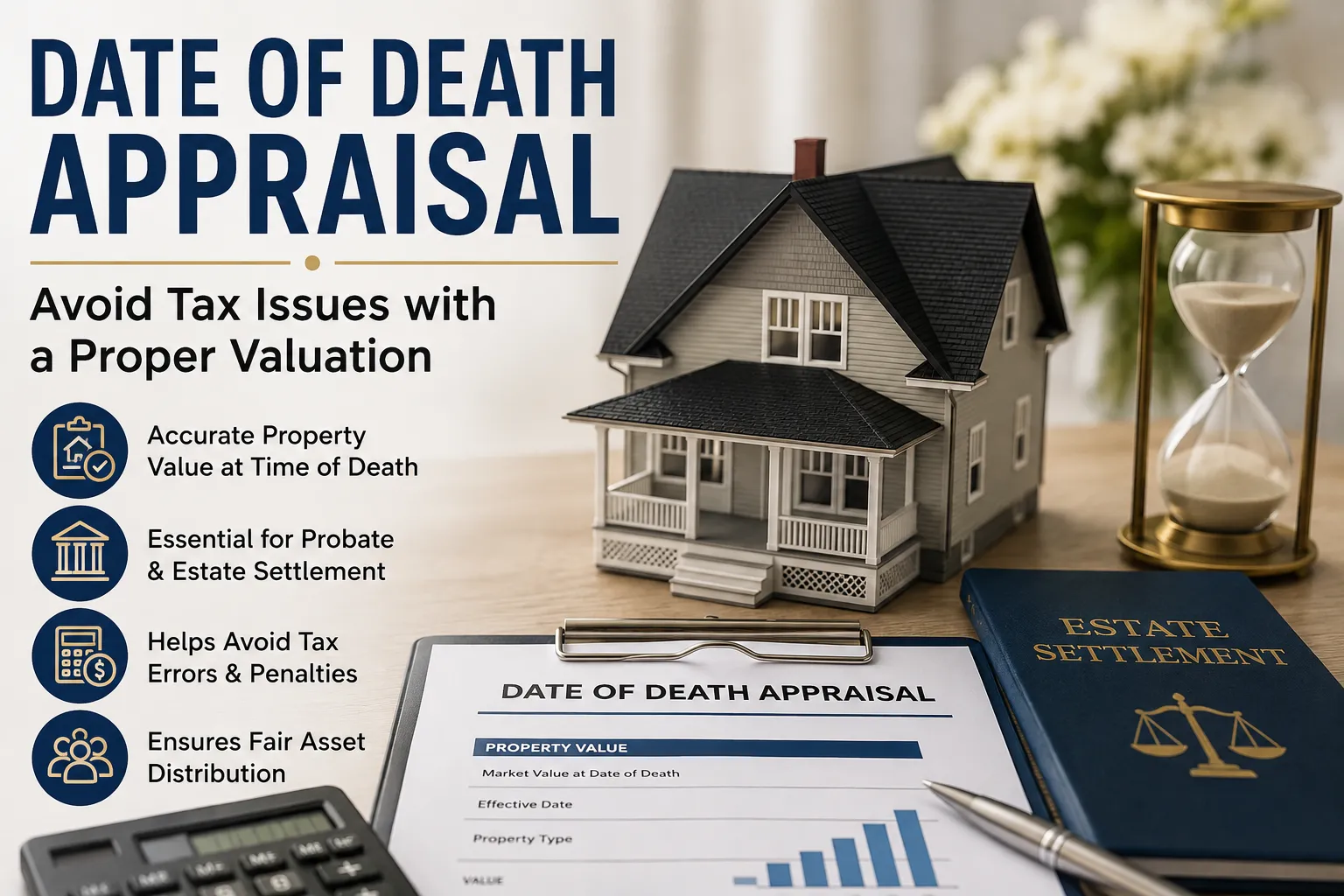
Avoid Tax Issues with a Proper Date of Death Appraisal

Date of death appraisal for accurate property valuation and tax planning

A date of death appraisal becomes the first real step when settling an estate because it locks in the property value at the exact moment someone passes away. This is not about today’s market, it is about that specific date, which is why a date of death appraisal is used in probate and legal tax filings.

What does a Date of Death Appraisal Really Mean?

A date of death appraisal is basically a snapshot of property value frozen in time. It shows what a house or land was worth on the day the owner passed away, not before and not after.

This is important because property prices move constantly, and only a date of death appraisal ensures legal accuracy during estate settlement.

What it includes

  • Market value at time of passing
  • Property condition at that exact date
  • Local real estate trends at that time
  • Comparable property sales from the same period

This is where property value assessment and appraised property value come into play, helping support a solid valuation report.

Why a Date of Death Appraisal is so Important in Probate

A date of death appraisal plays a major role in probate because courts rely on it to decide how assets are distributed and whether taxes apply.

Without a proper date of death appraisal, estate settlement can turn messy very quickly.

Key Reasons It Matters

  • Prevents incorrect tax calculations
  • Supports fair asset distribution
  • Reduces legal disputes among heirs
  • Ensures compliance with estate laws

It also helps answer common concerns like is inheritance taxable, since accurate valuation is the base of that calculation.

How property value is determined at the time of death

To establish a date of death appraisal, professionals study market conditions that existed on the exact date of passing.

This process includes:

Valuation steps

  • Reviewing similar property sales from that time
  • Checking property condition and maintenance level
  • Studying neighborhood demand during that period
  • Applying standard real estate tax valuation methods

This is how experts determine how to determine date of death value of property in a legally acceptable way.

A date of death appraisal ensures nothing is estimated based on guesswork or current prices.

Alternate valuation date rules and when it applies

Sometimes estates use an alternate valuation date instead of a date of death appraisal, which allows assets to be valued six months later.

This option is only used if it reduces estate taxes or benefits the overall estate.

When it is used

  • Property value drops after death
  • Market conditions change significantly
  • Tax savings become possible

Even then, a date of death appraisal is still usually required as the primary reference point.

Types of Appraisers Involved in Estate Valuation

Different professionals handle different parts of estate valuation depending on property type and complexity.

Residential appraiser

  • Handles homes and residential estates
  • Common in probate cases involving family property

Building appraisal

  • Used for commercial or mixed-use buildings
  • Includes structural and income analysis

Land appraisal services

  • Focus on raw land and development potential
  • Used in rural or agricultural estates

Appraisal companies

  • Provide full legal valuation reports
  • Handle complex estate portfolios

Each of these supports a strong and accurate date of death appraisal when required.

Assessed Value vs Market Value Confusion

Many estates get confused between assessed value and market value during probate.

TypeMeaning
Assessed valueGovernment tax value
Market valueReal selling price
Date of death valuationHistorical probate value

A date of death appraisal is closer to market value at a specific past moment, not tax-assessed numbers.

This difference is critical when handling property tax assessment or tax assessed value vs market value comparisons.

Date of death appraisal showing property valuation for probate and estate settlement

Cost of a Date of Death Appraisal and What Affects It

The date of death appraisal cost depends on how complex the property and estate are.

Factors Affecting Cost

  • Property size and condition
  • Location and market activity
  • Type of property involved
  • Level of documentation required

A simple residential date of death appraisal is usually more affordable than commercial estate valuation.

Common Mistakes During Estate Valuation

Mistakes in valuation can cause legal and financial issues later.

Avoid these errors

  • Using current market value instead of historical value
  • Skipping professional appraisal services
  • Ignoring property condition at time of death
  • Overlooking probate requirements

A properly done date of death appraisal avoids these problems completely.

Why Professional Valuation Makes Everything Easier

A proper date of death appraisal removes uncertainty from estate settlement.

Professionals use:

  • Historical market data
  • Legal probate rules
  • Physical property inspection
  • Comparable sales analysis

This ensures the estate process stays smooth and legally correct from start to finish.

Quick overview table

ConceptPurpose
Date of death appraisalLegal estate valuation
Alternate valuation dateOptional tax adjustment
Residential appraiserHome valuation expert
Property tax searchTax record verification
Appraised property valueMarket-based valuation

Conclusion

A properly handled date of death appraisal is the foundation of accurate estate planning, fair inheritance distribution, and correct tax reporting. Without it, estates risk disputes, delays, and unnecessary tax issues.

Frequently Asked Questions

What is a date of death appraisal and why is it required in estate settlement and probate valuation processes for property ownership transfer?

A date of death appraisal is a legal valuation that determines property worth at the exact time of death. It is required for probate so assets are divided fairly, taxes are calculated correctly, and legal ownership transfer is properly documented.

Who performs a date of death appraisal and what qualifications are required for residential and commercial estate valuation experts?

Certified residential appraisers or licensed valuation professionals perform these reports. They must understand probate law, real estate trends, and historical market analysis to produce legally accepted documentation.

Is inheritance taxable and how does a date of death appraisal affect estate tax calculation and legal compliance requirements?

Inheritance tax depends on jurisdiction, but a date of death appraisal determines estate value, which directly impacts whether taxes apply and how much is owed during probate settlement.

What is an alternate valuation date and when can it be used instead of a date of death appraisal in estate tax planning strategies?

An alternate valuation date allows assets to be valued six months after death. It is used only if it reduces estate taxes and is legally approved, but original valuation remains the primary reference.

How is property value determined using a date of death appraisal in house valuation for probate purposes and legal documentation?

It is determined by reviewing past market conditions, comparable sales, and property condition at the time of death. This ensures accurate historical value for probate court acceptance.

What factors influence date of death appraisal cost in residential and commercial property valuation services for estate planning?

Cost depends on property size, complexity, location, documentation needs, and whether the property is residential or commercial. More complex estates require more detailed valuation work.

Do estates require official house valuation for probate and how do appraisal companies support legal estate settlement processes?

Yes, most estates require official valuation. Appraisal companies provide certified reports that courts accept for probate, ensuring accurate asset distribution and legal compliance.

What is the difference between assessed value vs market value in property tax assessment and real estate valuation processes?

Assessed value is used for taxation by authorities, while market value reflects actual selling price. Neither replaces a date of death appraisal, which is based on historical value.

What happens if a date of death appraisal is incorrect in probate proceedings and estate valuation of personal property distribution?

Incorrect valuation can lead to tax penalties, legal disputes, delayed probate, and unfair inheritance distribution, making accurate appraisal essential for smooth estate settlement.

How to Remove PMI Insurance Faster and Save Thousands

How to remove PMI insurance faster and save thousands

PMI insurance is one of those extra costs that quietly adds up every month. Many homeowners don’t realize how much they’re paying over time or how quickly it can be removed with the right steps. Understanding how it works, when it ends, and how to speed up the process can save thousands without changing the loan itself.

This guide breaks everything down in a simple, practical way so the path to removing PMI insurance becomes clear and actionable.

What is PMI and Why It Exists

At its core, what is pmi comes down to lender protection. When a home is purchased with less than 20 percent down, lenders add private mortgage insurance pmi to reduce their risk.

This means:

  • The borrower pays monthly insurance
  • The lender gets protection if payments stop
  • The homeowner builds equity more slowly due to added cost

Typical pmi percentage ranges between 0.5 percent to 2 percent of the loan annually. That can translate into hundreds of dollars every month depending on the loan size.

How Much PMI Actually Costs

Understanding mortgage loan insurance cost helps show why removing it early matters.

Example Breakdown

Loan AmountPMI RateMonthly CostYearly Cost
200,0001%1672,000
300,0000.8%2002,400
400,0000.7%2332,800

Even with the cheapest pmi, the numbers stack up quickly over a few years.

When Does PMI Go Away Automatically

A common question is when does pmi go away without taking action.

Under the homeowners protection act, lenders must automatically cancel PMI insurance when:

  • The loan reaches 78 percent loan to value ratio
  • Payments are current
  • No additional liens exist

This rule comes from the pmi cancellation act, which ensures borrower protection and prevents lenders from charging indefinitely.

How to Cancel PMI Early

Waiting for automatic removal is not always the best move. There are faster ways to handle how to cancel pmi and reduce costs sooner.

Key Strategies

  • Reach 80 percent loan to value through payments
  • Request cancellation directly from the lender
  • Maintain a strong payment history
  • Avoid late payments or refinancing disruptions

Simple Process

  • Check current loan balance
  • Estimate home value
  • Submit cancellation request
  • Schedule appraisal if required

Taking these steps can speed up how to get rid of mortgage insurance by months or even years.

PMI removal checklist for saving on mortgage insurance

How to Drop PMI Faster with Smart Moves

Looking at how to drop pmi requires a mix of timing and strategy.

Smart Acceleration Methods

  • Make extra principal payments
  • Increase monthly payment slightly
  • Refinance when property value rises
  • Renovate to boost home value

Each of these helps reduce loan balance or increase equity, both of which impact PMI insurance removal. A house appraisal may also help establish the property’s current market value when determining whether sufficient equity has been reached.

Refinancing to Remove PMI

Refinancing is one of the fastest ways to eliminate PMI insurance, especially when home value increases.

When It Makes Sense

  • Property value has increased significantly
  • Interest rates are lower
  • Equity has crossed 20 percent

However, refinancing includes fees, so it only works if long term savings outweigh upfront costs.

PMI vs MIP: Know the Difference

Understanding mip vs pmi is important before making decisions.

FeaturePMIMIP
Loan TypeConventionalFHA
RemovalPossibleSometimes permanent
CostVariesFixed structure

PMI insurance can usually be removed, while MIP often stays for the life of the loan unless refinanced.

Can You Avoid PMI Completely

Some borrowers look for a no pmi mortgage option.

Options Include

  • 20 percent down payment
  • Piggyback loans
  • Lender paid PMI
  • VA loans

Each option has trade offs. For example, lender paid PMI increases interest rate, which can cost more over time.

Tax Benefits and Deductions

Many ask if is mortgage insurance tax deductible.

The mortgage insurance premium deduction has been available in certain years depending on income limits and tax laws. Checking current eligibility is important since rules change.

Even when deductions apply, the best financial move is still to remove PMI insurance as early as possible.

Quick Checklist to Remove PMI Faster

Action Plan

  • Track loan to value ratio regularly
  • Make extra payments toward principal
  • Monitor property value trends
  • Request cancellation at 80 percent threshold
  • Consider refinancing strategically

Following this checklist helps reduce reliance on PMI insurance and speeds up financial progress.

Common Mistakes That Delay PMI Removal

Avoid These

  • Waiting for automatic cancellation
  • Ignoring property value increases
  • Missing payments
  • Not requesting appraisal when eligible

Small delays can result in paying thousands more in PMI insurance than necessary.

Frequently Asked Questions

What is PMI insurance and why is it required?

PMI insurance is a monthly cost added to loans with less than 20 percent down. It protects lenders, not homeowners, and is required to reduce risk on low equity mortgages, which increases total borrowing cost significantly.

When does PMI go away on its own?

Under the homeowners protection act, PMI automatically ends when the loan reaches 78 percent of the original value, as long as payments are current and no other financial risks exist on the property.

How to cancel PMI early without refinancing?

To handle how to cancel pmi, request removal once equity reaches 20 percent, maintain a strong payment record, and provide proof through an appraisal if needed by the lender.

Is mortgage insurance tax deductible in current year?

The mortgage insurance premium deduction depends on tax laws and income thresholds. It has been available in some years but requires checking updated IRS guidelines before claiming benefits.

What is the difference between PMI and MIP?

The difference in mip vs pmi lies in loan type. PMI applies to conventional loans and can be removed, while MIP applies to FHA loans and may remain for the full loan term.

Can PMI be removed before reaching 80 percent equity?

Yes, in some cases lenders allow early removal if property value increases significantly, but this usually requires a formal appraisal and strong payment history.

What is the average PMI percentage?

The typical pmi percentage ranges from 0.5 percent to 2 percent annually based on credit score, loan size, and down payment, directly affecting monthly housing costs.

Are no PMI mortgage options worth it?

A no pmi mortgage can avoid monthly insurance costs, but may include higher interest rates or complex loan structures, making long term cost comparison essential before choosing.

How much does PMI add to monthly payments?

The mortgage loan insurance cost can add hundreds monthly depending on loan size and rate, making early removal of PMI insurance one of the most effective ways to save money over time.

7 Secrets to Accurate House Valuation That Save You Thousands

7 secrets for accurate house valuation and saving money

House valuation is one of those things that looks simple on the surface but quietly controls almost every financial decision in real estate. Whether someone is selling, buying, investing, or even handling taxes, everything starts from one point: house valuation.

And here’s the reality most people only learn later. If house valuation is wrong, everything after that becomes wrong too. Pricing, negotiations, taxes, even long-term returns get affected.

That’s why understanding house valuation properly is not optional. It is the foundation that protects money and prevents expensive mistakes that usually show up too late.

Secret 1: Value Is Built, Not Just Located

A strong house valuation is never just about where the property is. Location matters, yes, but it does not decide everything.

Real value is built through multiple layers that work together.

What actually shapes value:

  • Demand in the area right now
  • Condition of the property, not just age
  • Renovations and their real market impact
  • Nearby infrastructure and development
  • Buyer activity in that specific segment

Many people check a home value estimator and assume it is final. But that’s only a surface-level guess. Real house valuation always goes deeper than numbers on a screen.

Secret 2: The Market Always Tells the Truth

If there is one rule in house valuation, it is this: the market never lies.

What similar homes are selling for right now is the most honest indicator of value.

Why this matters so much:

  • Buyers don’t care about opinions, only prices
  • Market trends change quickly
  • Old data loses meaning fast

A proper house valuation is always based on recent, real transactions, not assumptions or outdated comparisons.

Secret 3: Professionals Don’t Estimate, They Analyze

A proper house valuation is never a guess. It follows structured methods that are tested and repeatable.

Experts don’t rely on emotion or rough thinking. They rely on systems.

Common valuation methods:

  • Market comparison approach
  • Cost replacement approach
  • Income or rental-based approach

When legal or financial accuracy is needed, a qualified appraisal becomes necessary. In official cases, only an irs qualified appraiser is trusted to produce a valid house valuation that can stand in legal or tax situations.

Secret 4: Taxes Can Quietly Change Everything

One of the most overlooked parts of house valuation is how deeply it affects taxes and inheritance planning.

People often only realize this when it’s already too late.

Important tax factors:

  • estate tax exemption 2025 may change what is tax-free
  • estate tax sunset 2025 could reduce exemptions in future planning
  • Incorrect valuation can increase tax burden significantly

Even gifting property requires accuracy. That is why an appraisal for gift tax purposes is often needed to keep house valuation legally safe and properly documented.

Key factors that affect accurate house valuation

Secret 5: Online Estimates Only Show Half the Picture

A big mistake in house valuation is trusting online tools as final truth.

They are helpful, but incomplete.

What they usually miss:

  • Interior upgrades and finish quality
  • Structural condition
  • Local demand differences street by street
  • Real buyer behavior in that area

Even when someone tries to appraise my house, what they get online is only a rough range, not a true house valuation that reflects real market conditions.

Secret 6: Land Issues Can Change Value Overnight

A house valuation is not just about the building. The land underneath often carries hidden value changes.

Small legal or boundary issues can shift pricing significantly.

Key factors include:

  • Property boundary accuracy
  • Zoning rules and restrictions
  • Survey clarity and updates
  • property line survey cost when disputes arise

In serious disputes, a real estate expert witness may be needed to explain and defend house valuation in legal proceedings.

Secret 7: Urgency Changes Everything in Value

A house valuation behaves very differently when a property is under financial pressure.

This is where real estate stops being normal and becomes urgent.

Common situations:

  • homes for bankruptcy
  • bankruptcy homes for sale
  • forced liquidation sales

In these cases, fair market value still exists, but actual selling prices often drop because time is limited and buyers know the urgency.

That is why house valuation must always consider context, not just numbers.

The Biggest Mistake People Keep Repeating

The most expensive mistake in house valuation is emotional pricing.

It sounds harmless, but it causes real financial loss.

People add emotional value:

  • memories attached to the home
  • money spent on renovations
  • personal expectations

But the market does not pay for emotions. It only responds to demand, condition, and data-based house valuation.

Fair Market Value Keeps Everything Grounded

Every serious house valuation eventually comes back to one thing: fair market value.

That simply means what a real buyer is willing to pay under normal conditions.

No pressure. No urgency. No emotional influence.

When house valuation aligns with fair market value, decisions become clearer, faster, and much safer financially.

Quick Comparison of Valuation Approaches

MethodAccuracy LevelWhen It Works Best
Online estimateLowQuick rough idea
Agent comparisonMediumBasic pricing decisions
Professional appraisalHighBuying/selling decisions
Legal valuationVery highCourt, tax, disputes

Each level of house valuation serves a different purpose depending on how serious the decision is.

Conclusion

At the end of the day, house valuation is not just a technical step. It is the starting point of every real estate decision that involves money.

When house valuation is accurate, everything else becomes easier: pricing, negotiation, selling, and even tax planning. When it is wrong, even a good property can turn into a financial mistake.

That is why treating house valuation seriously is not about theory. It is about protecting money, avoiding risk, and making decisions with clarity instead of guesswork.

Frequently Asked Questions

What hidden factors can silently impact house valuation without homeowners realizing it immediately?

House valuation can shift due to zoning changes, infrastructure projects, school ratings, neighborhood safety, and buyer demand patterns that are not always obvious at first.

Why is a qualified appraisal required instead of using a simple estimate for serious house valuation cases?

Qualified appraisal is needed because it provides legally accepted and verified house valuation used for tax reporting, legal disputes, and financial documentation with official credibility.

How do estate tax exemption 2025 changes influence house valuation in inheritance planning?

Estate tax exemption 2025 changes can reduce tax-free limits, making accurate house valuation essential for planning inheritance and avoiding unexpected tax obligations.

What role does property line survey cost play in determining final house valuation?

Property line survey cost matters because unclear boundaries can lower buyer confidence, while accurate surveys improve legal clarity and strengthen overall house valuation.

Why do bankruptcy homes for sale usually have lower house valuation compared to normal listings?

Bankruptcy homes for sale often have reduced house valuation due to urgency, financial pressure, and limited negotiation time, which forces quicker and lower-priced deals.

How does fair market value help in keeping house valuation realistic during buying or selling?

Fair market value ensures house valuation reflects real buyer behavior under normal conditions, preventing overpricing or underpricing caused by emotion or urgency.

When is a real estate expert witness needed in house valuation disputes?

A real estate expert witness is needed when house valuation becomes part of legal cases, inheritance conflicts, or disputes that require professional market validation.

What is the biggest long-term risk of relying on incorrect house valuation?

The biggest risk is financial loss through poor pricing decisions, either by selling below true value or overpricing and missing real buyers in the market.

How Trust Tax Rates Work: A Simple Guide for Beginners

How trust tax rates work with trust funds, property, tax planning, and estate assets

Trust tax rates are where most people get confused when they first step into estate planning. The idea sounds simple. Put assets into a trust, protect them, and everything becomes easier. But the moment income starts flowing, trust tax rates begin to play a major role in how much money is actually kept versus how much goes to taxes.

This is the part that is often overlooked. And this is exactly where better understanding leads to better decisions.

What a Trust Really Does

Think of a trust as a container. Assets go into it, and rules are attached to how those assets are managed and distributed.

Inside that structure:

  • A trustee manages everything
  • A beneficiary receives the benefits
  • The assets sit in what is commonly called a trust fund

This setup is widely used because it gives control, protection, and long-term planning advantages.

Why Trust Tax Rates Matter So Much

Here is the reality. trust tax rates are not designed like personal tax brackets. They are tighter, faster, and reach higher levels quickly.

That means:

  • Less income is needed to hit higher tax brackets
  • More income can be taxed at higher rates sooner

Simple Comparison

TypeTax Progression
IndividualGradual
TrustRapid

So when income stays inside the trust, trust tax rates can significantly reduce what remains.

How Income Is Handled Inside a Trust

Every trust generates income in some way:

  • Rental income
  • Investment returns
  • Business profits

Now the key question becomes: where does that income go?

Scenario 1: Income stays in the trust

  • It gets taxed using trust tax rates

Scenario 2: Income is distributed

  • It gets taxed in the hands of the beneficiary

This one decision alone can change the entire tax outcome.

Revocable vs Irrevocable Trusts Explained Simply

Revocable Trust

This is the flexible option.

  • Can be changed anytime
  • Income is reported on personal taxes
  • Often linked with living trust and taxes

There is no immediate impact from trust tax rates during the lifetime of the creator.

Irrevocable Trust

This is where things become more serious.

  • Cannot be easily changed
  • Becomes its own tax entity
  • Fully subject to trust tax rates

This is where planning matters the most.

Trust tax rates comparison showing income retained in a trust versus distributed to beneficiaries

Trust Identification and Filing Basics

Every trust needs to be recognized officially.

That is where:

  • trust ein number
  • trust identification number

come into play.

Without these:

  • Accounts cannot be opened
  • filing taxes for a trust becomes impossible

This is the administrative side, but it directly connects to compliance and penalties.

Property Inside a Trust

A large number of trusts are built around real estate.

That includes:

  • putting property into a trust
  • putting a house into a trust
  • transferring property into a trust

Why people do this:

  • Avoid probate
  • Maintain privacy
  • Simplify inheritance

But once the property generates income, trust tax rates step in again.

Can Property Be Removed From a Trust

This question comes up often: can you take a property out of a trust

The answer depends entirely on the structure.

  • Revocable trust → usually yes
  • Irrevocable trust → not so simple

Removing assets can trigger legal and tax consequences, especially under trust taxation rules.

Step Up in Basis and Why It Matters

This is one of the most important concepts to understand.

When assets pass through a trust, their value may reset.

Two key situations:

  • step up in basis revocable trust
  • irrevocable trust step up in basis

What it means:

  • Assets are valued at current market price
  • Capital gains tax is reduced when sold

This can protect a significant portion of wealth.

Trust Taxation vs Estate Taxes

These two are often mixed up, but they are not the same.

Trust Taxation

  • Ongoing
  • Based on income
  • Driven by trust tax rates

Estate Taxes

  • One-time
  • Applied at transfer of wealth
  • Part of broader estate taxes planning

Both need to be aligned properly.

Special Cases Like Special Needs Trusts

Some trusts are designed with specific purposes.

One example is:

  • special needs trust taxation

These trusts are structured carefully to:

  • Protect benefits eligibility
  • Provide financial support

And still follow strict taxation rules.

Estimated Tax Payments for Trusts

Trusts do not just wait until the end of the year.

They often require:

  • estimated tax payments for trusts

Why this matters:

  • Avoid penalties
  • Spread tax burden
  • Stay compliant

Ignoring this can increase overall costs quickly.

Role of the Trustee and Beneficiary

The structure only works when roles are clear.

Trustee:

  • Manages assets
  • Makes decisions
  • Ensures compliance

Beneficiary:

  • Receives income or assets

This relationship directly affects how trust tax rates apply.

Living Trust and Taxes Made Simple

A living trust is often the starting point.

During lifetime:

  • No separate tax
  • Income flows to personal return

This is where taxes on living trust stay simple.

After death:

  • It may convert into a taxable trust
  • trust tax rates begin to apply

Trusts and Inheritance Tax Planning

When inherited property is involved, a Date of Death Appraisal can help establish an accurate value for estate and tax-related purposes.

Trusts are often used to manage:

  • trusts and inheritance tax exposure

The goal is simple:

  • Reduce tax burden
  • Protect assets
  • Control distribution

But without proper planning, taxes can still be high.

Estate Planning Services and Strategy

Professional estate planning services are often used to:

  • Structure trusts properly
  • Align tax strategy
  • Avoid common mistakes

Because once income starts flowing, trust tax rates cannot be ignored.

Smart Ways to Handle Trust Tax Rates

Practical approaches:

  • Distribute income when possible
  • Avoid unnecessary accumulation
  • Choose the right trust type
  • Plan property transfers carefully

Each of these reduces pressure from trust tax rates over time.

Common Mistakes That Cost Money

  • Keeping too much income inside the trust
  • Ignoring trust tax rates early on
  • Incorrect filing taxes for a trust
  • Poor handling of property transfers

These mistakes are more common than expected and often expensive.

Frequently Asked Questions

What are trust tax rates in simple terms?

Trust tax rates are the tax brackets applied to trust income. They reach higher levels faster than personal taxes, which means income inside a trust can be taxed more heavily if not managed properly.

Why do trust tax rates reach higher levels faster?

Trust tax rates are compressed, meaning smaller amounts of income move into higher tax brackets quickly. This is why planning distributions becomes important for reducing total tax liability.

Do all trusts pay taxes the same way?

No, different trusts follow different rules. Revocable trusts pass income to the owner, while irrevocable trusts are taxed separately under trust taxation rules and structures.

What is a trust EIN number used for?

A trust ein number is used for identification when opening accounts and filing returns. It is essential for filing taxes for a trust and maintaining compliance with tax authorities.

Can property be removed from a trust easily?

It depends on the type of trust. Revocable trusts allow flexibility, but irrevocable ones are restrictive. The question can you take a property out of a trust depends on legal structure and terms.

How does step up in basis help reduce taxes?

A step up in basis revocable trust adjusts asset value to current market levels, which reduces capital gains tax when the asset is sold by beneficiaries after inheritance.

Are taxes on living trust complicated?

taxes on living trust are usually simple during the owner lifetime because income is reported personally. Complexity increases only when the trust becomes a separate taxable entity later.

What is special needs trust taxation?

Special needs trust taxation follows strict rules to ensure that beneficiaries can receive support without losing eligibility for government assistance programs or benefits.

Why are estimated tax payments needed for trusts?

estimated tax payments for trusts help avoid penalties and manage tax obligations throughout the year, especially when the trust generates regular income from assets or investments.

Do trusts help reduce estate taxes?

Trusts can reduce estate taxes when structured correctly. They are often used in combination with broader strategies to manage wealth transfer and minimize overall tax exposure.

How to Accurately Calculate the Value of Your Home in 2026

How to accurately calculate your home value in 2026 using market trends, comparable sales, upgrades, and professional appraisal

The value of your home—let’s be real—isn’t some number you pull out of the air. It’s not what your neighbor thinks it’s worth or that figure Zillow throws at you. In 2026, it’s a mix of market moves, smart tools, upgrades you’ve done, and yes, buyer behavior. Knowing it properly can save you a ton of money and headache.

A lot of people ask: How do I find the property value of my home? or What’s the current value of my property? Most get it wrong because they rely on guesses or outdated info. Let’s fix that. Here’s how to actually figure it out.

Why the value of your home matters right now

Let’s be honest: this number touches everything in your life if you own property.

  • Selling? It decides your asking price. Too high, nobody bites. Too low, you lose money.
  • Refinancing? Your lender cares about this.
  • Taxes? Yep, higher value can mean higher property taxes.
  • Insurance? Underestimating it could leave you undercovered.

Outdated assumptions about the value of your home? That’s a fast track to losing money or making bad choices.

What really drives the value of your home

Don’t be fooled—it’s not just the size of the house. It’s several moving pieces:

Location

  • Are buyers fighting to live in your neighborhood?
  • Any new developments, parks, or schools?
  • Accessibility: commuting matters more than ever.

Condition of the Home

  • Old roof or leaky plumbing? That counts.
  • Upgrades? Kitchens and bathrooms matter the most.
  • Structural issues? That can tank your home’s value fast.

Market Conditions

  • Is it a seller’s market or buyer’s market?
  • Interest rates influence what people can afford.
  • Local buyer sentiment—sometimes it’s not logic, it’s emotion.

Comparable Sales

  • Homes like yours that just sold nearby.
  • Square footage, rooms, condition—adjust for differences.

This is the first step to understanding how a house valuation is done.

Key factors affecting home value including location, property condition, comparable sales, market conditions, and upgrades

Step-by-Step: How to Value Your Home Without Guesswork

1. Start with a Baseline Estimate

Online tools give a quick home appraisal. Think of it as a rough first look—not gospel.

Search for:

  • most accurate home value estimator
  • current home values

It gives a number, but it doesn’t know your home’s quirks or charm.

2. Check Out the Competition

Look at homes that recently sold near you:

  • Same size, same number of bedrooms and bathrooms
  • Similar condition and age

This gives a realistic idea of the present market value of my home.

3. Adjust for What Makes Your Home Unique

No two homes are identical. Add or subtract for:

  • Renovated kitchen or bathrooms
  • Smart home or energy-efficient upgrades
  • Outdoor spaces or premium views

These tweaks can bump the value of your home higher.

4. Time It Right

Timing can be everything.

  • Seller’s market? You can price more aggressively.
  • Buyer’s market? Price strategically to attract offers.

Watching current market value of home trends is key—you can’t just price by last month’s numbers.

5. Bring in a Professional

A licensed appraiser gives the appraisal value of my house through:

  • Physical inspection
  • Market research
  • Local expertise

It’s essential for serious financial moves, like refinancing or bankruptcy appraisal.

Table: What Really Moves Home Value

FactorWhy It Matters
LocationBuyers pay premium for the right spot
ConditionFixing big issues adds serious value
Market TrendsKnowing timing prevents mistakes
Comparable SalesReal numbers from nearby homes
Upgrades & FeaturesSmart improvements add premium

Common Ways to Evaluate Your Home

  • Comparative Market Analysis: Real estate agents do this using local sales.
  • Automated Valuation Models: Online tools; fast, but not perfect.
  • Professional Appraisal: Most reliable, often required for loans or legal cases.

Use all three for the clearest picture.

Mistakes That Hurt the value of your home

  • Thinking emotionally: “I love it, so it must be worth more.”
  • Ignoring needed repairs—buyers notice.
  • Relying only on online tools—they don’t see everything.
  • Forgetting market timing—it changes fast.

Even one misstep can throw off your value of your home drastically.

Tech Makes It Easier, But Don’t Forget Human Insight

2026 tools are impressive:

  • AI valuation tools
  • Real-time market data
  • Satellite imagery and predictive models

They make it faster to find property value of my home, but nothing beats a professional check.

When Should You Recalculate?

  • Market shifts
  • Renovations
  • Preparing to sell or refinance
  • Economic changes

Keeping an eye on the current value of my house keeps decisions smart and informed.

Quick Checklist to Nail Home Value

  • Check online estimators
  • Review comparable sales
  • Adjust for upgrades
  • Analyze market trends
  • Get a professional appraisal

Follow this and your value of your home isn’t a guess—it’s a number you can trust.

Conclusion:

The value of your home changes constantly. Market shifts, your property’s condition, and buyer behavior all affect it. Figuring it out right takes a mix of tools, data, and expert advice. Do it properly, and every financial choice about your home becomes easier and safer.

Frequently Asked Questions

What’s the most accurate way to determine the value of your home?

A professional appraisal paired with recent comparable sales gives the truest picture. Online tools offer a starting point, but they fall short on details.

How often should the value of your home be calculated?

Check it yearly, or right after big renovations, market changes, or key financial moves like selling or refinancing.

Can online tools give the exact value of your home?

No, they just estimate based on broad data. Unique home features and local nuances need a pro’s eye for precision.

What increases the value of your home the most?

Location tops the list, followed by major kitchen or bathroom updates and top-notch condition throughout. 

Does renovation always increase home value?

Only if it matches buyer expectations. Over-improving can sometimes not pay off.

What is a bankruptcy appraisal?

A legal valuation of your home during bankruptcy to determine fair asset value.

How do market trends affect home value?

In a seller’s market, prices rise; in a buyer’s market, they drop. Timing matters.

Is appraisal value the same as market value?

Not exactly. Appraisal value is structured; market value depends on what buyers will actually pay.

What is the difference between assessed value and market value?

Assessed value is for taxes; market value is what you can sell the home for right now.

How can someone quickly estimate home value before selling?

Check online tools, look at recent nearby sales, and ask a real estate agent.