Trust tax rates are where most people get confused when they first step into estate planning. The idea sounds simple. Put assets into a trust, protect them, and everything becomes easier. But the moment income starts flowing, trust tax rates begin to play a major role in how much money is actually kept versus how much goes to taxes.
This is the part that is often overlooked. And this is exactly where better understanding leads to better decisions.
What a Trust Really Does
Think of a trust as a container. Assets go into it, and rules are attached to how those assets are managed and distributed.
Inside that structure:
- A trustee manages everything
- A beneficiary receives the benefits
- The assets sit in what is commonly called a trust fund
This setup is widely used because it gives control, protection, and long-term planning advantages.
Why Trust Tax Rates Matter So Much
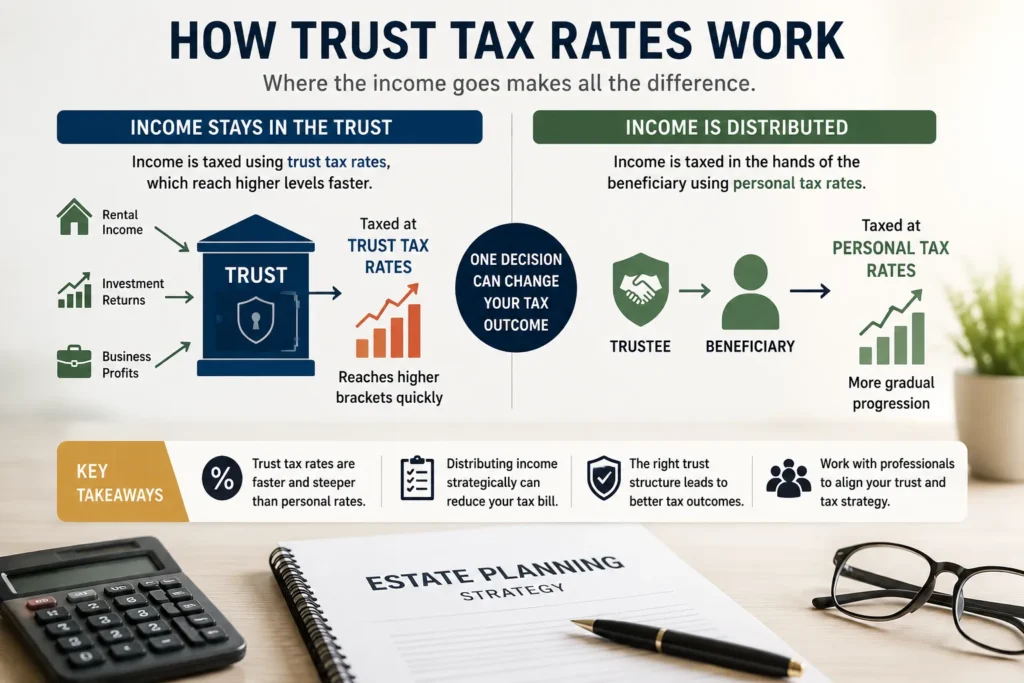
Here is the reality. trust tax rates are not designed like personal tax brackets. They are tighter, faster, and reach higher levels quickly.
That means:
- Less income is needed to hit higher tax brackets
- More income can be taxed at higher rates sooner
Simple Comparison
| Type | Tax Progression |
| Individual | Gradual |
| Trust | Rapid |
So when income stays inside the trust, trust tax rates can significantly reduce what remains.
How Income Is Handled Inside a Trust
Every trust generates income in some way:
- Rental income
- Investment returns
- Business profits
Now the key question becomes: where does that income go?
Scenario 1: Income stays in the trust
- It gets taxed using trust tax rates
Scenario 2: Income is distributed
- It gets taxed in the hands of the beneficiary
This one decision alone can change the entire tax outcome.
Revocable vs Irrevocable Trusts Explained Simply
Revocable Trust
This is the flexible option.
- Can be changed anytime
- Income is reported on personal taxes
- Often linked with living trust and taxes
There is no immediate impact from trust tax rates during the lifetime of the creator.
Irrevocable Trust
This is where things become more serious.
- Cannot be easily changed
- Becomes its own tax entity
- Fully subject to trust tax rates
This is where planning matters the most.
Trust Identification and Filing Basics
Every trust needs to be recognized officially.
That is where:
- trust ein number
- trust identification number
come into play.
Without these:
- Accounts cannot be opened
- filing taxes for a trust becomes impossible
This is the administrative side, but it directly connects to compliance and penalties.
Property Inside a Trust
A large number of trusts are built around real estate.
That includes:
- putting property into a trust
- putting a house into a trust
- transferring property into a trust
Why people do this:
- Avoid probate
- Maintain privacy
- Simplify inheritance
But once the property generates income, trust tax rates step in again.
Can Property Be Removed From a Trust
This question comes up often: can you take a property out of a trust
The answer depends entirely on the structure.
- Revocable trust → usually yes
- Irrevocable trust → not so simple
Removing assets can trigger legal and tax consequences, especially under trust taxation rules.
Step Up in Basis and Why It Matters
This is one of the most important concepts to understand.
When assets pass through a trust, their value may reset.
Two key situations:
- step up in basis revocable trust
- irrevocable trust step up in basis
What it means:
- Assets are valued at current market price
- Capital gains tax is reduced when sold
This can protect a significant portion of wealth.
Trust Taxation vs Estate Taxes
These two are often mixed up, but they are not the same.
Trust Taxation
- Ongoing
- Based on income
- Driven by trust tax rates
Estate Taxes
- One-time
- Applied at transfer of wealth
- Part of broader estate taxes planning
Both need to be aligned properly.
Special Cases Like Special Needs Trusts
Some trusts are designed with specific purposes.
One example is:
- special needs trust taxation
These trusts are structured carefully to:
- Protect benefits eligibility
- Provide financial support
And still follow strict taxation rules.
Estimated Tax Payments for Trusts
Trusts do not just wait until the end of the year.
They often require:
- estimated tax payments for trusts
Why this matters:
- Avoid penalties
- Spread tax burden
- Stay compliant
Ignoring this can increase overall costs quickly.
Role of the Trustee and Beneficiary
The structure only works when roles are clear.
Trustee:
- Manages assets
- Makes decisions
- Ensures compliance
Beneficiary:
- Receives income or assets
This relationship directly affects how trust tax rates apply.
Living Trust and Taxes Made Simple
A living trust is often the starting point.
During lifetime:
- No separate tax
- Income flows to personal return
This is where taxes on living trust stay simple.
After death:
- It may convert into a taxable trust
- trust tax rates begin to apply
Trusts and Inheritance Tax Planning
When inherited property is involved, a Date of Death Appraisal can help establish an accurate value for estate and tax-related purposes.
Trusts are often used to manage:
- trusts and inheritance tax exposure
The goal is simple:
- Reduce tax burden
- Protect assets
- Control distribution
But without proper planning, taxes can still be high.
Estate Planning Services and Strategy
Professional estate planning services are often used to:
- Structure trusts properly
- Align tax strategy
- Avoid common mistakes
Because once income starts flowing, trust tax rates cannot be ignored.
Smart Ways to Handle Trust Tax Rates
Practical approaches:
- Distribute income when possible
- Avoid unnecessary accumulation
- Choose the right trust type
- Plan property transfers carefully
Each of these reduces pressure from trust tax rates over time.
Common Mistakes That Cost Money
- Keeping too much income inside the trust
- Ignoring trust tax rates early on
- Incorrect filing taxes for a trust
- Poor handling of property transfers
These mistakes are more common than expected and often expensive.
Frequently Asked Questions
What are trust tax rates in simple terms?
Trust tax rates are the tax brackets applied to trust income. They reach higher levels faster than personal taxes, which means income inside a trust can be taxed more heavily if not managed properly.
Why do trust tax rates reach higher levels faster?
Trust tax rates are compressed, meaning smaller amounts of income move into higher tax brackets quickly. This is why planning distributions becomes important for reducing total tax liability.
Do all trusts pay taxes the same way?
No, different trusts follow different rules. Revocable trusts pass income to the owner, while irrevocable trusts are taxed separately under trust taxation rules and structures.
What is a trust EIN number used for?
A trust ein number is used for identification when opening accounts and filing returns. It is essential for filing taxes for a trust and maintaining compliance with tax authorities.
Can property be removed from a trust easily?
It depends on the type of trust. Revocable trusts allow flexibility, but irrevocable ones are restrictive. The question can you take a property out of a trust depends on legal structure and terms.
How does step up in basis help reduce taxes?
A step up in basis revocable trust adjusts asset value to current market levels, which reduces capital gains tax when the asset is sold by beneficiaries after inheritance.
Are taxes on living trust complicated?
taxes on living trust are usually simple during the owner lifetime because income is reported personally. Complexity increases only when the trust becomes a separate taxable entity later.
What is special needs trust taxation?
Special needs trust taxation follows strict rules to ensure that beneficiaries can receive support without losing eligibility for government assistance programs or benefits.
Why are estimated tax payments needed for trusts?
estimated tax payments for trusts help avoid penalties and manage tax obligations throughout the year, especially when the trust generates regular income from assets or investments.
Do trusts help reduce estate taxes?
Trusts can reduce estate taxes when structured correctly. They are often used in combination with broader strategies to manage wealth transfer and minimize overall tax exposure.