How Professional Appraisers Use Recent Home Sales, Neighborhood Characteristics, and Property Features to Determine Market Value
Determining the market value of a home in Logan Square, Chicago, involves more than looking at what a neighboring property recently sold for. Although comparable sales are one of the most important tools used in residential real estate appraisals, selecting the right properties and understanding the differences between them requires careful research, local market knowledge, and professional analysis.
Logan Square is a distinctive Chicago neighborhood with a diverse mix of residential properties. From historic greystones and classic Chicago bungalows to two-flats, condominium buildings, and newer construction, the neighborhood offers a variety of housing styles and property configurations. These differences can have a significant impact on how homes are valued.
For homeowners considering selling, refinancing, removing private mortgage insurance (PMI), settling an estate, or simply understanding their property’s current market value, knowing how comparable sales work can make the appraisal process easier to understand.
IAS Residential Appraisal Services, based in Chicago, provides professional residential appraisal services throughout Chicago and the surrounding communities in Cook, Lake, and DuPage counties. Understanding local housing characteristics and analyzing relevant comparable sales are important parts of developing accurate, independent opinions of residential property value.
In this guide, we’ll explain how comparable sales influence residential appraisals in Logan Square, what appraisers look for when selecting comparable properties, and why neighborhood-specific market knowledge matters when determining what a Chicago home is worth.
What Are Comparable Sales in a Residential Appraisal?
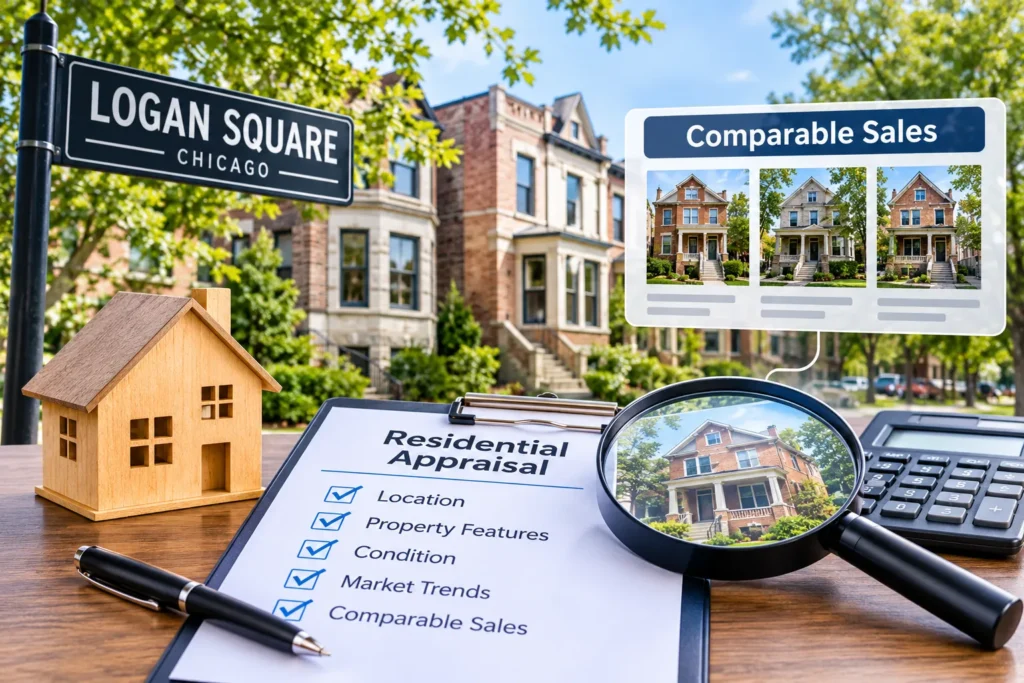
Comparable sales, commonly referred to as comps, are recently sold properties that share important characteristics with the home being appraised.
Appraisers analyze these properties to understand how buyers and sellers are interacting in the local real estate market.
The goal is to identify properties that provide meaningful evidence of what a typical buyer would likely pay for a home similar to the subject property.
When evaluating comparable sales, an appraiser generally considers:
- Location and neighborhood characteristics.
- Recent sale dates and market conditions.
- Above-grade living area.
- Bedroom and bathroom count.
- Property age and architectural style.
- Overall condition and quality of construction.
- Renovations and property improvements.
- Lot size and exterior features.
- Garage and parking accommodations.
- Basement features and finished living areas.
No two homes are exactly alike. Even properties located on the same block can have substantial differences in size, condition, layout, and functionality.
For this reason, an appraiser does not simply average the sale prices of nearby homes. Instead, the appraiser analyzes the similarities and differences between the subject property and the comparable sales, making appropriate adjustments when supported by market evidence.
The resulting analysis helps establish a credible opinion of market value.
Why Comparable Sales Are Especially Important in Logan Square
Logan Square has a residential real estate market that requires careful property-specific analysis.
Unlike neighborhoods dominated by one particular housing style, Logan Square contains a wide range of residential buildings, including:
- Historic greystones and brick two-flats.
- Traditional Chicago bungalows.
- Three-flat and four-flat apartment buildings.
- Single-family homes.
- Condominium units.
- Converted residential buildings.
- Newer infill construction.
According to the Chicago Metropolitan Agency for Planning’s community data, Logan Square has a substantial concentration of two-to-four-unit residential buildings, reflecting the neighborhood’s distinctive housing character. Its housing stock also includes condominiums, single-family homes, and larger apartment buildings.
This variety makes comparable selection particularly important.
For example, a renovated single-family greystone may not be appropriately compared with a newer condominium simply because both properties are located within Logan Square.
Similarly, a two-flat with rental income potential has different characteristics from a traditional single-family residence.
An appraiser must understand the property type, intended use, physical features, and market segment before determining which sales provide the strongest valuation evidence.
The boundaries and characteristics of the immediate neighborhood also matter. A property near Logan Boulevard may have different location characteristics from one closer to a major commercial corridor.
Even within Logan Square, neighborhood influences and property differences can affect buyer preferences and sale prices.
How Appraisers Select the Right Comparable Properties
Selecting comparable sales is one of the most important parts of a residential appraisal.
The objective is not necessarily to find the three closest houses. It is to identify properties that most closely resemble the subject property and reflect the same competitive market.
Here are some of the primary considerations.
1. Location and Neighborhood Similarity
Location is a major influence on residential property value.
When appraising a home in Logan Square, an appraiser generally begins by researching sales within the immediate neighborhood or other locations that compete in the same market.
Important considerations may include:
- Proximity to Logan Boulevard and Kedzie Boulevard.
- Access to Milwaukee Avenue and Fullerton Avenue.
- Nearby shopping, restaurants, and neighborhood businesses.
- Access to public transportation.
- Surrounding residential development.
- Differences in neighborhood character.
A comparable property does not always have to be on the same block as the subject property. However, any differences in location must be evaluated to determine whether they influence market value.
If suitable comparable sales are limited within the immediate area, an appraiser may expand the search to nearby neighborhoods when those properties represent a reasonable alternative for potential buyers.
2. Property Type and Architectural Style
Property type is another important consideration.
A traditional Chicago two-flat should generally be compared with other similar multi-unit properties when possible.
A condominium should be evaluated against comparable condominium sales rather than automatically relying on nearby single-family home transactions.
Architectural characteristics can also influence value.
Logan Square includes historic brick buildings, greystones, vintage apartment properties, and newer construction. Differences in architectural design, layout, construction quality, and functionality may affect how buyers perceive and value a property.
The appraiser considers these characteristics when determining which sales are most relevant.
3. Living Area and Property Size
The size of a home is another important factor in comparable sales analysis.
Appraisers consider the property’s above-grade living area, bedroom and bathroom count, basement features, and overall layout.
For example, two homes may both have three bedrooms, but one may offer substantially more living space, an additional bathroom, and a more functional floor plan.
Those differences can influence market value.
It is also important to understand that basement space is generally analyzed separately from above-grade living area. A finished basement may contribute value, but it is not automatically treated as equivalent to above-grade square footage.
In Chicago, where many older homes have basements, this distinction can be especially relevant.
4. Property Condition and Renovations
The condition of a home can significantly influence its market position.
A recently renovated property may appeal to buyers differently than a similar home with outdated kitchens, older bathrooms, or deferred maintenance.
Appraisers examine features such as:
- Kitchen and bathroom updates.
- Flooring and interior finishes.
- Roof and exterior condition.
- Heating and cooling systems.
- Windows and doors.
- Electrical and plumbing updates.
- Overall maintenance and quality of construction.
However, renovation costs do not automatically translate into equal increases in appraised value.
The appraiser evaluates whether comparable sales demonstrate that buyers are willing to pay more for similar improvements.
5. Sale Date and Market Conditions
The timing of a comparable sale also matters.
Real estate market conditions can change over time due to interest rates, available inventory, buyer demand, and broader economic influences.
A property that sold several months ago may provide useful information, but its sale price may need to be considered in the context of current market conditions.
Appraisers generally prioritize recent, relevant transactions when available.
If older sales are necessary because of limited comparable properties, the appraiser evaluates whether market conditions have changed since those transactions occurred.
Understanding Appraisal Adjustments: Why Similar Homes Can Have Different Values
Even when two homes appear similar, differences in their features may influence their respective values.
This is where appraisal adjustments become important.
An adjustment accounts for a measurable difference between the subject property and a comparable sale when the market indicates that the difference affects value.
For example, consider two properties in Logan Square:
- Property A is a three-bedroom home with two bathrooms, an updated kitchen, and a detached garage.
- Property B is a similar three-bedroom home with one bathroom, an older kitchen, and no garage.
Although the properties may be similar in size and location, buyers may recognize differences in functionality, condition, and parking.
The appraiser analyzes those differences and determines whether adjustments are appropriate based on market evidence.
Common areas of comparison include:
Living area: Differences in above-grade square footage may influence value.
Bathrooms: Additional bathrooms may provide functional benefits that buyers recognize.
Condition: Updated and well-maintained properties may compare differently from homes requiring significant repairs.
Parking: Garage spaces and parking availability can be important considerations in Chicago neighborhoods.
Basement features: Finished space, ceiling height, accessibility, and overall utility may affect market appeal.
Outdoor space: Private yards, patios, decks, and other exterior features may contribute to buyer preferences.
Property configuration: Single-family homes, condominiums, and multi-unit buildings serve different buyer markets and require appropriate comparable sales.
Adjustments are not based on arbitrary dollar amounts. They should be supported by market evidence and professional analysis.
Why Chicago Neighborhood Knowledge Matters When Choosing Comparable Sales
One of the biggest challenges in residential appraisal work is understanding how different Chicago neighborhoods function as real estate markets.
Two properties may be relatively close geographically but have different housing characteristics, buyer expectations, and market influences.
For example, Logan Square has a distinctive mix of historic residential architecture, multi-unit buildings, and newer development.
Nearby neighborhoods such as Bucktown, Avondale, Humboldt Park, and Palmer Square may provide useful market context in certain assignments. However, proximity alone does not make a property an appropriate comparable sale.
The appraiser must determine whether buyers would realistically consider the properties competitive alternatives.
This is particularly important when appraising unique properties, including:
- Historic homes with distinctive architectural features.
- Renovated greystones.
- Two-flats and three-flats.
- Multi-unit investment properties.
- New construction homes.
- Condominiums in converted buildings.
A property-specific approach helps prevent inappropriate comparisons and supports a more credible opinion of value.
Common Misconceptions About Comparable Sales and Home Appraisals
Homeowners often have questions about why their appraisal value differs from what they expected.
Several common misconceptions can create confusion.
The Closest Home Is Always the Best Comparable
Not necessarily.
A nearby property may have a different size, condition, design, or property type. A slightly farther property may provide stronger evidence of market value if it is more similar to the subject home.
The Highest Recent Sale Determines My Home’s Value
A high sale price does not automatically establish the value of another property.
The appraiser must consider whether the sale is comparable in terms of location, features, condition, and other relevant characteristics.
My Home Is Worth What I Spent on Renovations
Renovation expenses and contributory market value are not the same.
A homeowner may invest substantially in improvements without receiving an equivalent increase in appraised value.
Online Home Value Estimates Are the Same as Professional Appraisals
Online estimates can provide general information, but they typically cannot account for every property-specific detail.
A professional residential appraisal involves a more detailed analysis of the property’s condition, features, comparable sales, and local market conditions.
All Homes in the Same Neighborhood Have Similar Values
Even within Logan Square, residential properties can differ significantly.
A condominium, single-family home, and two-flat may occupy similar locations but serve different markets and require different valuation approaches.
When Should You Order a Residential Appraisal in Logan Square?
Homeowners may need a professional appraisal for several reasons beyond buying or selling a property.
Refinancing a Mortgage
A homeowner considering refinancing may need an appraisal to establish the property’s current market value.
Removing Private Mortgage Insurance
If you believe your home has increased in value or your mortgage balance has declined sufficiently, an appraisal may help support a request for PMI removal, subject to your lender’s requirements.
Selling a Home
An independent appraisal can provide additional information when evaluating a potential asking price or reviewing a property’s market position.
Buying a Property
A residential appraisal can provide an independent opinion of value that may help buyers better understand a property’s market position.
Estate and Divorce Matters
An appraisal may be needed to establish property value for estate settlement, inheritance distribution, divorce proceedings, or other legal and financial purposes.
Property Tax Concerns
Homeowners who believe their property’s assessed value does not accurately reflect its market value may benefit from a professional appraisal when preparing for a property tax appeal. Requirements vary depending on the applicable assessment process.
The intended use of the appraisal helps determine the appropriate scope and reporting requirements.
How to Prepare Your Logan Square Home for an Appraisal
Preparing for an appraisal does not require extensive renovations or expensive staging.
However, homeowners can take a few practical steps to help ensure the appraiser has accurate information about the property.
- Make a list of improvements. Document kitchen renovations, bathroom updates, roof replacements, window upgrades, and other significant work.
- Gather property information. Provide available details about additions, finished basements, bedroom and bathroom configurations, and other property features.
- Keep renovation records. Contractor invoices, permits when applicable, and warranties can help document completed improvements.
- Provide access to all relevant areas. Make sure the appraiser can access bedrooms, basements, garages, utility areas, and other parts of the property.
- Address basic maintenance concerns. Ordinary maintenance can help the appraiser observe the property’s overall condition.
- Share relevant property details. If the home has unique architectural features, recent improvements, or unusual characteristics, provide that information when appropriate.
- Avoid relying exclusively on online estimates. Automated estimates may not reflect the property’s actual condition or the most appropriate comparable sales.
The purpose of an appraisal is to determine market value based on the property and available market evidence, not how much money has been spent preparing the home for inspection.
The Importance of Professional Residential Appraisal Services in Chicago
A reliable residential appraisal requires more than identifying recent sales and calculating an average price per square foot.
Every property has unique characteristics that must be considered within its local market.
In a neighborhood like Logan Square, where historic homes, condominiums, multi-unit buildings, and newer construction exist side by side, choosing the right comparable sales is particularly important.
IAS Residential Appraisal Services provides independent residential property valuations throughout Chicago and the surrounding communities in Cook, Lake, and DuPage counties.
The company’s approach emphasizes property-specific research, relevant comparable sales, and an understanding of the characteristics that influence residential real estate values throughout the Chicago metropolitan area.
Whether you own a condominium near Milwaukee Avenue, a historic greystone, a traditional Chicago bungalow, or a multi-unit residential property, understanding its market value requires careful consideration of its features and the properties with which it competes.
Working with a professional residential appraiser can provide an independent valuation perspective for important financial and real estate decisions.
Conclusion: Understanding Comparable Sales Helps You Understand Your Home’s Value
Comparable sales are one of the most important components of a residential appraisal, but selecting the right properties requires careful consideration.
In Logan Square, differences in architectural style, property type, living area, condition, renovations, and location can have a meaningful influence on market value.
A nearby sale is not automatically a suitable comparable, and the highest recent sale does not necessarily establish what another home is worth.
The most credible appraisal analysis considers the property’s unique characteristics and compares them with relevant transactions that reflect the same competitive real estate market.
If you are a homeowner in Logan Square or another Chicago neighborhood and need an independent opinion of your property’s value, IAS Residential Appraisal Services can help you better understand the residential appraisal process.
Based in Chicago, IAS Residential Appraisal Services serves homeowners throughout Chicago, Cook County, Lake County, and DuPage County.
Contact IAS Residential Appraisal Services to discuss your residential appraisal needs and learn more about obtaining a professional property valuation.
Frequently Asked Questions About Residential Appraisals and Comparable Sales in Logan Square
1. What are comparable sales in a Chicago home appraisal?
Comparable sales are recently sold properties that share important characteristics with the home being appraised. Appraisers analyze their location, size, condition, property type, features, and sale prices to help determine the subject property’s market value. The most useful comparable sales are those that compete in the same market and closely resemble the property being evaluated.
2. How many comparable sales are used in a residential appraisal?
A typical residential appraisal using the sales comparison approach often includes three or more comparable sales. However, the number can vary depending on property type, market conditions, and the availability of suitable transactions. The quality and relevance of the comparable sales are more important than simply including a large number of properties.
3. Does a comparable home have to be located in Logan Square?
No. Appraisers generally begin by researching sales within the subject property’s immediate neighborhood. However, if suitable comparable sales are limited, they may consider properties in nearby neighborhoods such as Bucktown, Avondale, or Humboldt Park when those properties represent a reasonable alternative in the same competitive market. Location differences must be analyzed appropriately.
4. Why is my Logan Square home appraised for less than a nearby property?
Several factors can explain differences in appraised value, including living area, condition, renovations, bathroom count, garage accommodations, property type, and lot characteristics. Even homes located on the same block can have significantly different features. An appraiser evaluates these differences when analyzing comparable sales.
5. Are condominiums and two-flats valued differently from single-family homes?
Yes. Condominiums, two-flats, and single-family homes have different characteristics and appeal to different buyer groups. Appraisers generally seek comparable sales of similar property types. For condominiums, factors such as unit size, floor level, building condition, amenities, and association characteristics may also be relevant. For multi-unit properties, the number of units and their configuration are important considerations.
6. Does renovating my Logan Square home increase its appraised value?
Renovations can positively influence appraised value, particularly when they improve functionality, condition, or overall appeal. Updated kitchens, bathrooms, mechanical systems, and finished living areas may contribute value. However, the amount spent on improvements does not automatically equal the amount added to the property’s market value. Appraisers analyze how buyers recognize similar improvements in comparable sales.
7. Can I challenge a home appraisal if I believe the comparable sales are incorrect?
If you believe an appraisal contains inaccurate information or inappropriate comparable sales, you can ask the lender or appraisal client about its reconsideration of value process, when applicable. Providing factual information, such as overlooked comparable sales, incorrect property measurements, or missing improvements, may help clarify the valuation analysis. Any reconsideration should be based on relevant and verifiable information.
8. Who provides residential appraisals in Logan Square and throughout Chicago?
IAS Residential Appraisal Services provides professional residential appraisal services throughout Chicago and surrounding communities in Cook, Lake, and DuPage counties. Homeowners seeking an independent opinion of market value can contact the company to discuss their property and appraisal requirements.