
The conversation usually starts the same way. A homeowner opens the property tax bill. Looks at the number. Then a real estate website opens. Look at another number. And suddenly the question comes out. How can the same house have two different values?
The house did not change overnight. Nobody added another bedroom. Nobody built a second floor. So why are the numbers different?
The answer is actually very simple.
- One value is there for taxes.
- One value is there for the real estate market.
That is why understanding assessed value vs market value matters. These two numbers belong to the same home, but they are trying to answer two completely different questions.
Think of it like this. One person is asking: How much tax should this house pay? Another person is asking: How much would somebody buy this house for today?
Those answers are rarely exactly the same.
And that is perfectly normal.
What is Assessed Value?
Many homeowners search what is assessed value after seeing the number on their tax statement. The easiest explanation is this. The government needs a number to calculate taxes. That number is called assessed value. The local assessor reviews property information and assigns a value.
The assessed value of property helps determine:
- Property taxes
- School taxes
- County taxes
- Local government taxes
The tax office is not trying to guess what buyers will offer next week.
Their job is simply determining taxable value. That is why the Property Assessed Value may stay the same even while home prices rise.
Think About Your Car for a Minute
A car dealership may offer one price. An insurance company may use another value. A private buyer may offer something completely different. The car itself has not changed. The purpose of the value changed.
Homes work the same way. The tax office sees one value. The market sees another. This is the heart of assessed value vs market value.
What is Market Value?
Now imagine putting a For Sale sign in front of the house. People start scheduling showings. Buyers walk through the rooms. Agents discuss pricing. Offers begin arriving.
- One buyer offers $390,000.
- Another offers $405,000.
- Someone offers $420,000.
The number buyers are willing to pay becomes the market value. That value changes because of:
- Location
- Demand
- Interest rates
- Home condition
- School districts
- Upgrades
- Local market conditions
Unlike tax values, market values move constantly. That is another reason assessed value vs market value often shows different numbers.
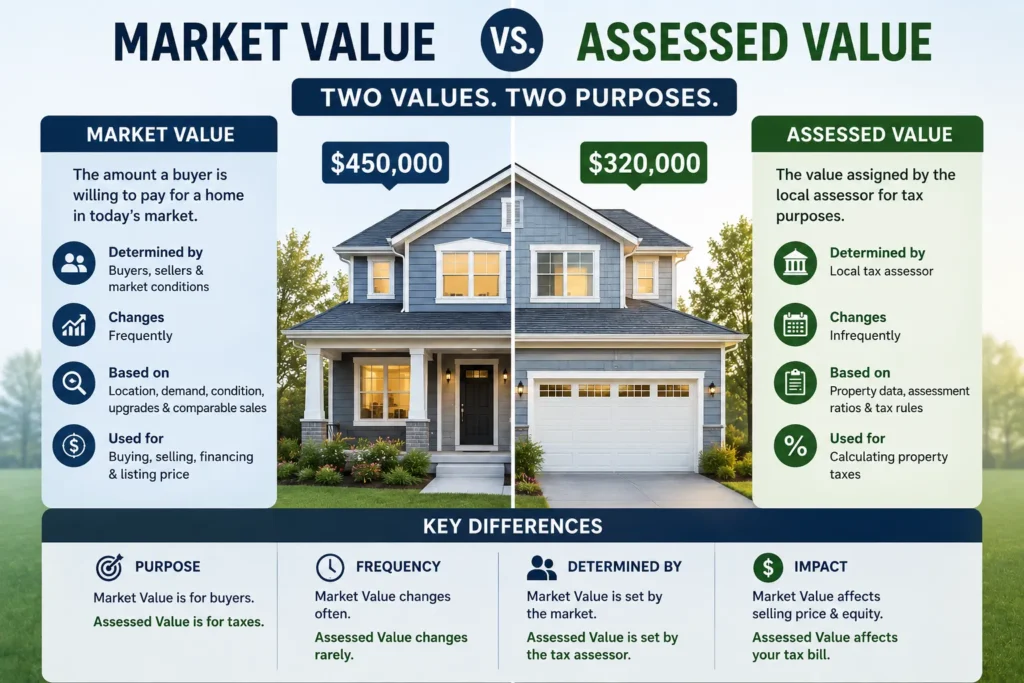
Assessed Value vs Market Value: The Kitchen Table Explanation
Imagine sitting at the kitchen table with a friend. The friend asks: What is your house worth? The answer depends on the question. If the friend asks: How much are your property taxes based on? The assessed value matters.
If the friend asks: How much could you sell it for? The market value matters. Sometimes people make this much more complicated than it really is. The truth is simple.
One number belongs to the tax office.
One number belongs to buyers.
| Question | Assessed Value | Market Value |
| Used for taxes | Yes | No |
| Used for selling | No | Yes |
| Changes quickly | Usually no | Often |
| Determined by | Tax assessor | Buyers and market |
| Used by lenders | Rarely | Yes |
Why is Assessed Value Usually Lower?
This is probably the biggest question homeowners ask. My house could sell for $500,000. So why does my tax bill say $350,000? Several things happen.
The housing market moves fast. The tax office moves slowly. Home prices can rise in a few months. Assessments may happen every few years.
Some states limit how much assessments can increase. Some improvements are not immediately recorded. Because of these reasons, assessed value vs market value often creates a large gap.
How is Market Value Determined?
Many sellers ask How Is Market Value Determined before listing their homes.
Imagine two houses. Same neighborhood. Same size. Same number of bedrooms. One has a remodeled kitchen. One needs repairs. The updated house usually sells for more. Market value comes from things buyers care about.
Recent Sales
What nearby homes sold for.
Condition
How well the property has been maintained.
Location
The neighborhood often matters as much as the house itself.
Demand
More buyers usually mean higher prices.
Appraisals
Professional opinions also help establish value.
This is why assessed value vs market value can never always match perfectly.
How is Assessed Value Calculated?
Many homeowners ask How Is Assessed Value Calculated after receiving their assessment notice.
The tax office may review:
- Property size
- Lot size
- Home age
- Building characteristics
- Local market data
- Assessment ratios
For example:
| Item | Amount |
| Market Value | $400,000 |
| Assessment Rate | 80% |
| Assessed Value | $320,000 |
That amount becomes the Property Assessed Value.
Understanding Property Tax Assessment
A Property Tax Assessment affects annual tax bills. Think of it this way. Higher assessment. Higher taxes. Lower assessment. Lower taxes. The calculation usually looks like this:
Property tax = Assessed value × Tax rate
That is why homeowners watch assessments carefully. Even small changes can affect yearly expenses.
Does Assessed Value Decide the Selling Price?
Not really.
Imagine a homeowner saying:
The county says my house is worth $280,000, so that is my asking price. Meanwhile, every home nearby sells for $375,000. The market does not care what the tax bill says.
Buyers care about:
- Location
- Updates
- Layout
- Neighborhood
- Schools
- Competition
The Assessed Value of a Home rarely determines the final selling price.
Home Value Assessment Methods
A Home Value Assessment can come from several places. A real estate agent may give one value. An appraiser may give another. An online estimator may show something different.
The tax office may have another number. This often confuses homeowners. But every value serves a different purpose.
Can the Assessed Value Be Wrong?
Absolutely. Mistakes happen. The county may list the wrong square footage. The number of bathrooms may be incorrect. An unfinished basement may be listed as finished. A homeowner may discover errors only after reviewing records. Understanding assessed value vs market value helps identify these issues.
When Home Prices Rise Fast
Picture a neighborhood becoming extremely popular. Homes sell in three days. Buyers compete. Prices increase every month. Yet the tax records still show values from several years ago. The gap grows wider. This is often when homeowners first realize that market value and assessed value are not the same thing.
Which Number Should Matter Most?
That depends on the situation. Selling the home? Market value. Buying the home? Market value. Paying taxes? Assessed value. Appealing taxes?
Both values. Refinancing? Market value. Building equity? Market value.
Every number has a purpose. The key is understanding when each one matters.
Conclusion:
The confusion usually starts with two numbers. One house. Two values. At first it feels wrong. But it really is not. The tax office is asking one question. The housing market is asking another.
One value determines taxes. One value determines the selling price. Neither number is incorrect.
They simply tell different stories about the same property.
And once homeowners understand assessed value vs market value, the numbers stop being confusing and start becoming useful.
Frequently Asked Questions
What is assessed value?
Assessed value is the amount assigned by local tax authorities to calculate property taxes and may not reflect what the home could sell for today.
Why is assessed value lower than market value?
Assessment schedules, local tax laws, and delayed updates often cause assessed values to remain below current market prices.
What determines market value?
Buyer demand, neighborhood conditions, home features, location, and recent sales all contribute to market value.
Does assessed value affect selling price?
Most buyers focus on market conditions and comparable sales rather than property tax assessments.
How often are homes reassessed?
Assessment schedules vary, with some areas reassessing annually and others updating values every few years.
Can renovations increase assessed value?
Major improvements may eventually increase assessed values during future reassessments.
Can homeowners appeal assessments?
Yes. Property owners can challenge assessments if they believe the value is inaccurate.
Why do online estimates differ?
Online estimates follow market conditions while tax assessments follow local government rules.
Which value matters for refinancing?
Lenders usually focus on market value because it reflects current property worth.
Why is understanding both values important?
Knowing both values helps homeowners understand taxes, equity, selling prices, refinancing options, and financial planning.