
Investment property is where the whole real estate decision actually starts in the residential rental world. Before any deal moves forward, before any mortgage lender gives approval, and before any buyer feels confident, there is one thing that quietly controls everything: the appraisal.
With an property, it is never just about how nice the place looks or how big it feels. It always comes down to something much more practical. How much money can it realistically make in the rental housing market, and what would a buyer actually pay for it today if everything was put on the table?
That is exactly what the appraisal process tries to answer in a very structured, data-backed way.
What is Actually Happening in an Investment Property Appraisal
When dealing with a property, the appraisal is basically a reality check. It strips away emotion and focuses only on numbers, demand, and market behavior.
In simple terms, it keeps asking:
- What is this property worth in today’s housing market
- How much rent can this investment generate month after month
- Does the income actually justify the price and the loan being requested
So instead of opinions, everything gets broken into facts that mortgage lenders can rely on.
How Value is Actually Formed for Investment
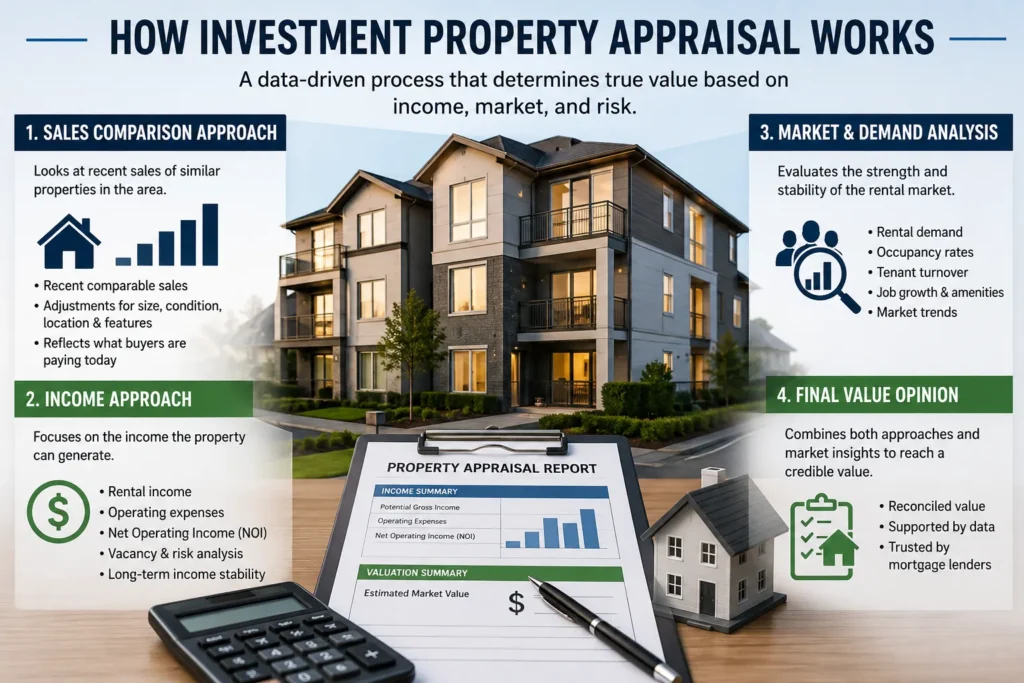
For an investment, value is never picked randomly. It is built using two main approaches that work together like two sides of the same story.
Sales Comparison Approach (What the Market is Paying)
This approach simply looks around and asks: what are similar homes selling for right now?
For an investment, this means:
- checking recent sales in the same area
- comparing size, layout, condition, and upgrades
- adjusting value based on differences
- reflecting what real buyers are paying today
So if nearby homes are selling high, the property naturally gets pulled upward in value. If the market is slow, value adjusts down.
It is basically the market speaking through numbers.
Income Approach (what the property earns)
Now this is where things get more important for rentals.
With an investment, the focus shifts from “what it looks like” to “what it produces.”
This approach looks at:
- rental income coming in every month
- operating costs and maintenance
- vacancy periods and risk
- net operating income
- long-term rental stability
This is the method mortgage lenders trust the most when the property is clearly meant for renting.
Because at the end of the day, income is what keeps the investment alive.
Why Income Tells the Real Story of Investment Property
A property does not survive on appearance. It survives on cash flow.
So appraisers carefully study:
- fair market rent in the area
- rental demand and tenant interest
- occupancy rates over time
- how quickly units get filled
- whether tenants stay or leave frequently
When rent is strong and occupancy is steady, the investment becomes much more valuable. When vacancies rise, value naturally drops even if the building itself looks perfect.
That is how sensitive rental value really is.
The Numbers that Quietly Decide Everything
In every property appraisal, a few financial terms carry most of the weight.
Gross Rent Multiplier (GRM)
This is a quick way to judge efficiency.
- compares property price with annual rent
- shows how many years it takes to “pay back” value through rent
- helps quickly compare multiple property options
Lower GRM usually signals a stronger deal.
Net Operating Income (NOI)
This is where real strength shows.
For any investment property, NOI is calculated like this:
- total rent collected
- minus all operating expenses
- excluding mortgage payments
The higher the NOI, the stronger the property is considered. It directly affects final valuation.
Rental Demand and Occupancy: The Heartbeat of Value
A property only performs if people actually want to live in it.
That is why appraisers pay attention to real-world signals like:
- how fast rentals get filled in the area
- whether demand stays consistent year-round
- local job growth and migration trends
- access to transport, schools, and services
- how often units stay vacant
High occupancy means stability. And stability pushes investment value higher.
Low occupancy signals risk, and risk pulls value down.
Different Property Types, Different Valuation Behavior
Not every property is treated the same in appraisal.
Single-family rental homes
- mostly judged by sales comparison
- rental income used as supporting data
Multi Family Properties
- heavily based on income approach
- each unit contributes to total valuation
Small Apartment Buildings
- strong focus on occupancy and NOI
- long-term rental performance matters most
Manufactured Homes
- stricter evaluation rules
- condition and land ownership matter more
So every property category behaves differently during valuation.
What Mortgage Lenders are Really Trying to Protect
Mortgage lenders are not just approving a property. They are protecting their money.
So for any property, they focus on:
- whether the value is realistic in the current market
- whether rent can support long-term repayment
- whether vacancy risk is under control
- whether the property will hold value over time
If anything feels unstable, the lender becomes cautious, even if the property looks good on paper.
How the Full Appraisal Process Flows?
Here is how it typically unfolds for any property:
- physical inspection of the property
- collecting market and rental data
- analyzing comparable sales nearby
- calculating income performance
- applying both valuation approaches
- adjusting based on market conditions
- final appraisal report sent to lender
Every step is designed to remove guesswork from the investment value.
How the Housing Market Quietly Changes Everything
A property is never isolated from the economy around it.
- in a strong housing market, prices rise quickly
- in a slow market, appraisers become conservative
- in high rental demand areas, income value increases
- in oversupplied areas, rent pressure reduces valuation
So even a strong property can lose value if the market weakens.
Timing matters more than most people realize.
Putting it all together
Think of a property appraisal like a three-layer decision:
- what similar properties are selling for
- what rent the property can realistically generate
- how stable the market and tenants are
All three layers combine into one final number that mortgage lenders trust completely.
Conclusion:
An investment is never valued based on guesswork or appearance. It is always shaped by income, demand, and market behavior.
When rent is steady, occupancy is strong, and demand stays healthy, the property naturally rises in value. When those weaken, value adjusts down, no matter how good the structure looks.
That is how residential real estate appraisal actually works in the real world.
Frequently Asked Questions
How does an investment property appraisal decide the final value?
An investment property appraisal decides value by combining rental income, comparable sales, and market demand to reflect what buyers would realistically pay today.
Why is income so important in investment property appraisal?
Income is important because an property is meant to generate cash flow, so rent, occupancy, and expenses directly determine its real financial strength.
What role does mortgage lenders play in investment property appraisal?
Mortgage lenders use the appraisal to confirm the property is worth the loan amount and that rental income can support repayment safely over time.
How does rental demand affect investment property value?
High rental demand increases property value because it reduces vacancy risk and ensures consistent rental income in the long term.
What is gross rent multiplier in property valuation?
Gross rent multiplier compares property price to annual rent to quickly judge how efficiently an property generates rental returns.
Why do occupancy rates matter so much for property?
Occupancy rates matter because they show how consistently a property earns income and how stable tenant demand is in the area.
How does housing market condition change investment property appraisal?
A strong housing market increases property value through higher comparable sales, while weaker markets reduce valuation expectations.
What makes small apartment buildings different as property?
Small apartment buildings rely heavily on rental income and occupancy, so their investment property value is mostly driven by income performance.
How is net operating income used in investment property appraisal?
Net operating income shows true profitability after expenses, making it one of the most important factors in property valuation.
What happens if an investment property appraisal comes lower than expected?
If the appraisal is low, mortgage lenders may reduce loan approval, require renegotiation, or ask for a higher down payment on the property.